By Evans Armantrading, CEO of CNU Stretch · Stretch Therapy Education
For years, I watched the same problem repeat itself inside stretch therapy sessions — the problem of intensity. A client would be mid-session, and their therapist would ask them to rate their stretch therapy intensity on a scale of one to ten. Not because they knew what a six felt like versus an eight. But because they were trying to figure out the right number.
The number that sounded accurate. The number that wouldn’t make them seem dramatic or seem weak. The number the therapist probably wanted to hear.
That moment of guessing — that hesitation — was costing everyone in the room. Clients weren’t communicating what their body was actually experiencing. Therapists were making decisions based on data that wasn’t real. For years, I watched it play out the same way. And the session outcomes reflected it. Some clients got overstretched and left sore or irritated. Others were understretched and left wondering if anything had actually happened. For newer practitioners trying to develop their instincts, it could take 200 to 300 hours of hands-on experience just to start reading a client’s body well enough to compensate for the broken feedback loop.
There had to be a better way. I just hadn’t found it yet.
They weren’t telling me what they felt. They were trying to pick the right number.
The Stoplight That Changed Everything
I wasn’t in a session when it came to me. I wasn’t reading research or sitting in a seminar. I was at a stoplight.
The light was red. I was thinking about client communication — about the feedback problem we kept running into — and then the light turned green. And something just clicked. Green means go. Yellow means slow down. Red means stop.
Three signals. Universally understood. No ambiguity. No guessing. No math.
Every person who has ever driven a car — or walked across a street — already knows exactly what green, yellow, and red mean in their body. It’s instinctive. It’s pre-loaded. You don’t have to think about it. And that’s precisely what made it the right framework for stretch therapy communication. We weren’t asking clients to learn something new. We were asking them to apply something they already knew to a new context.
We started implementing the Green-Yellow-Red system across our gyms — and the difference was immediate.
What Each Signal Actually Means
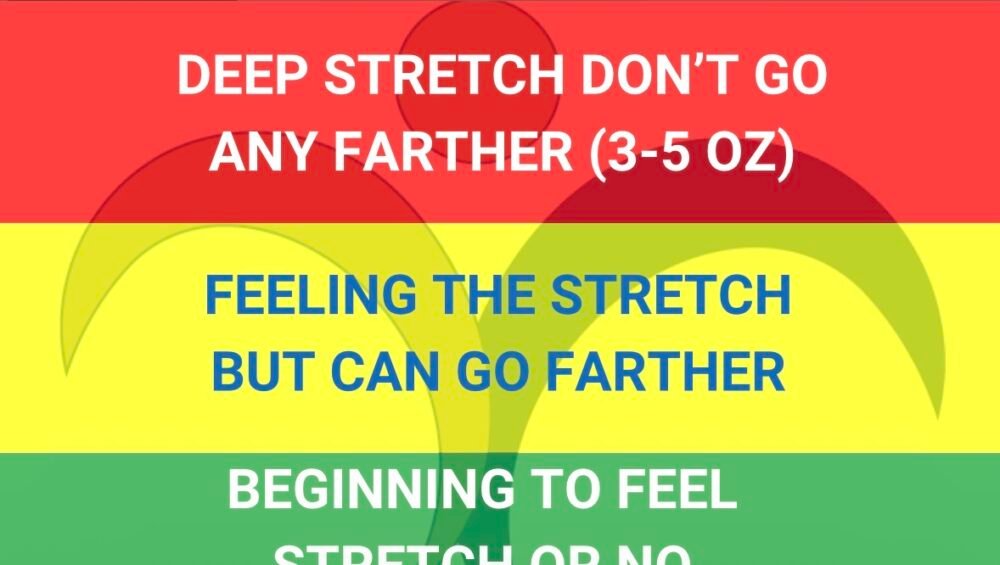
The framework is simple by design. Three zones, each with a clear definition that both client and therapist understand from the very first session:
🟢 Green — Beginning to Feel the Stretch
Minimal tension, easy breathing. The body is relaxed and the nervous system feels safe. This is where tissue warms up and trust is built between client and therapist.
🟡 Yellow — The Target Zone
A clear, satisfying, deep stretch that still feels manageable. The client can breathe and relax while the muscle lengthens. This is where real mobility improvements happen — this is where you want to live.
🔴 Red — Back Off Slightly
The stretch is approaching pain. This is the signal for the therapist to ease back until the client returns to yellow. A touch of red tells you you’ve found the edge — don’t live there.
A great stretch therapy intensity session should be mostly green and yellow — with just a touch of red. Think of it like smoked paprika on potato salad. A little adds real depth. Too much, and you’ve ruined the whole dish.
Why Stretch Therapy Intensity and Communication Quality Changes Everything
Here’s what most people don’t realize about stretching: it’s not purely a mechanical process. You’re not just lengthening a muscle fiber the way you’d stretch a rubber band. The nervous system is involved in every single moment of a stretch session — and the nervous system responds to perceived threat.
When a stretch crosses into pain, the body interprets that as danger. The nervous system sends a signal to contract and protect the muscle. The very tissue you’re trying to open tightens up in response. This is the stretch reflex — and it’s the reason that aggressive, painful stretching so often produces the opposite of the intended result. You push past the edge, the body guards, and the client leaves tighter than when they arrived.
The Green-Yellow-Red system works because it keeps the session inside the nervous system’s comfort zone. When a client is in green or yellow, their body stays relaxed. The muscle can actually lengthen. Progress happens. And because the client is in control of the signal — not guessing, not performing — the feedback is accurate and the therapist can make real-time decisions based on real information.
That shift in communication quality changes the entire arc of a session. Clients feel heard. They feel safe. They stop bracing and start releasing. And the outcomes follow.
We weren’t asking clients to learn something new. We were asking them to apply something they already knew.
What Happened When We Implemented It
After rolling out the GYR system across our gyms, client satisfaction increased noticeably. People raved about their sessions in a way that was different from before — not just “that felt good,” but a genuine sense of having moved better, felt looser, and recovered faster. The quality of the feedback loop changed the quality of the entire experience.
But the shift I didn’t fully anticipate was what it did for new stretch therapists.
Before GYR, developing a confident, skilled touch took hundreds of hours. A new practitioner would spend their first 200 to 300 sessions essentially calibrating — learning to read micro-expressions, tension in the body, subtle cues that a client was approaching their limit. Some practitioners never fully developed it. They either played it too safe and understretched, or they pushed too hard and lost the client’s trust.
With GYR, that calibration period collapsed almost overnight. Because the client was now communicating clearly and in real time, the new practitioner didn’t have to guess. Day one out of certification, someone brand new to stretch therapy could deliver a quality session — because the system gave them the feedback they needed to do their job well.
Day one out of certification, a new therapist could deliver a quality session — because the client was now in control of the intensity.
The Deeper Lesson About Client Control
There’s something important underneath the mechanics of this system worth naming directly: clients perform better when they feel in control.
The traditional pain scale puts the client in a passive role. They’re being assessed. They’re trying to answer correctly. That dynamic creates a subtle tension that works against the relaxation a good stretch session requires.
The GYR system flips that entirely. The client isn’t being evaluated — they’re giving direction. They’re the authority on their own experience. That shift in agency matters physiologically, not just psychologically. A client who feels in control relaxes more easily. A client who relaxes more easily allows the stretch to work more effectively. The system isn’t just a communication tool — it’s a trust-building mechanism built directly into the methodology.
When clients trust the process and feel heard inside it, they come back. They refer people. They become advocates. The communication framework and the business outcome are not separate things.
Why This Matters for Every Fitness Professional
If you’re a personal trainer, group instructor, or coach, you’ve almost certainly hit the wall this system is designed to break through. Clients who plateau not because their programming is wrong, but because their body can’t move the way it needs to. Stiffness, limited range of motion, chronic tension that no amount of foam rolling seems to touch.
Stretch therapy is the missing piece — and the GYR system is the reason a fitness professional can begin delivering effective sessions immediately after certification, not after hundreds of hours of trial and error. It puts the tools in your hands and the feedback mechanism in your client’s, creating a session environment where real progress can happen from day one.
The stoplight moment on that drive years ago turned into a methodology that has now been applied across hundreds of sessions, with practitioners at every experience level, producing outcomes the pain scale never could.
Green means you’re warming up. Yellow means you’re in the work. Red means you’ve found the edge — and it’s time to come back.
That’s the system. And it changes everything.
Get Certified — Upcoming Training Dates
- Coeur d’Alene, ID — April 11–12
- Dover, DE — April 18–19
- Dover, DE – April 23 – 24
- Richmond, VA — May 2 – 3
- Northern VA — Coming Soon
- Hood River, OR — October 30–31