Hiring Stretch Therapy Staff for Your Gym | CNU Stretch
Hiring stretch therapy staff is the single most important decision you’ll make when building a gym stretch program. You can have the best marketing, the right pricing, and the perfect table setup — but if the person delivering sessions isn’t competent and confident, the program won’t hold.
This guide walks gym owners through exactly how to find, hire, train, and certify stretch therapy staff — whether you’re building from scratch or expanding an existing program.
Should You Hire a Stretch Therapist or Certify Your Existing Staff?
The honest answer: both paths work. The right one depends on two factors — capacity and drive.
Capacity is how many hours your existing staff can realistically dedicate to stretch therapy. Not in theory — in practice. If your trainers are already running full client loads, pulling them into stretch sessions creates a coverage problem somewhere else. If there’s genuine availability in their schedules, certifying internally is usually faster and cheaper than onboarding someone new.
Drive is your goal with the program. Are you adding stretch therapy as a supplemental service — something a few clients use a few times a week? Or are you building it into a dedicated revenue line with its own schedule, its own client base, its own growth targets? The bigger the ambition, the stronger the case for bringing in someone whose entire role is stretch therapy from day one.
If your staff has capacity and your goal is to add stretch as a complementary service, certify internally. If your staff is at capacity, or you want stretch therapy to carry real revenue weight from the start, hire externally — then get them trained through a legitimate certification program, or find someone who’s already certified in a method that holds up.
One thing most gym owners don’t think about until it’s a problem: if only one person on your team is certified in stretch therapy, your program is fragile. That person gets sick, leaves, or goes on vacation — and your program stops. Certifying at least two staff members, regardless of which path you take, is what separates a sustainable program from a single-point-of-failure situation. We’ve seen successful stretch therapy programs run out of gyms with four staff members and gyms with twenty. Team size doesn’t determine success. Redundancy does.
What Makes Someone a Good Stretch Therapist
Most gym owners approach this wrong. They look for the most credentialed trainer on their team, or the one with the most anatomy knowledge, and assume that person will translate into a great stretch therapist. Sometimes it works. Often it doesn’t.
Stretch therapy is less about what someone knows and more about who they are. The technical skills are teachable. The following are much harder to train:
High emotional intelligence. A stretch therapist is working with clients in a vulnerable position — literally and figuratively. Clients are on a table, often dealing with chronic pain or mobility limitations they’ve struggled with for years. The ability to read a room, pick up on non-verbal cues, and make someone feel genuinely cared for isn’t something a certification creates. Either someone has it or they don’t.
A genuine curiosity about how the body works. Not a degree in kinesiology — curiosity. The therapists who get really good, really fast are the ones who find anatomy genuinely interesting. They ask questions after sessions. They think about why a technique worked. That intrinsic interest accelerates everything the training teaches.
Empathy backed by a real story. The best stretch therapists have a personal connection to pain or recovery — either their own experience or someone close to them. That’s not a requirement, but it shows up consistently in the people who build deep client loyalty. Clients can feel the difference between someone going through the motions and someone who actually understands what chronic tightness or limited mobility costs you day to day.
The ability to be present. Stretch therapy is one-on-one, focused, and relational. It rewards the trainer who can give one client their complete attention for 25 or 50 minutes — not the one who thrives on the energy of a packed group class. Some of your best high-energy coaches may not be your best stretch therapists, and that’s fine. They’re different skills serving different clients.
When you’re evaluating your existing team — or interviewing outside candidates — lead with these qualities. A trainer with all four of these traits and no stretch background will outperform a credentialed therapist who lacks them within six months of solid training.
Where to Find Your Next Stretch Therapist
Job boards
Job boards are your widest net. Indeed is the most obvious starting point, but Jazz HR is worth the investment because a single post distributes across multiple boards simultaneously — saving you the time of managing separate listings while reaching the same volume of candidates.
Social media
Don’t underestimate a well-crafted Facebook or Instagram post. There’s a meaningful population of people who already have a personal interest in stretch therapy — either as clients or as curious fitness enthusiasts — who are quietly looking for exactly this kind of opportunity. They’re not browsing Indeed. They’re scrolling. Meet them there.
Your own client base
This is the most overlooked recruiting source and often the best one. Your existing clients have already experienced what stretch therapy does. They’ve felt the results. Some of them have quietly thought “I think I’d love doing this for people.” They just haven’t been asked.
There’s also a practical advantage here that most gym owners miss: stretch therapy doesn’t require the level of physical conditioning that personal training does. A stretch therapist can come in at a more deconditioned fitness level and still be genuinely aspirational to clients — because what clients are responding to is skill, empathy, and results, not physique. That’s a meaningful contrast to personal training, where a visibly deconditioned trainer can quietly undermine client confidence. Your next best stretch therapist might already be on your table.
Hiring Stretch Therapy Staff from Outside Your Team
If you’ve decided external hiring is the right path, the candidate pool is broader than most gym owners expect. You’re not looking for a unicorn — you’re looking for the right raw material.
Personal trainers, massage therapists, athletic trainers, physical therapy assistants, nurses, and kinesiology graduates are all strong starting points. What they share is a foundation in the body — movement patterns, muscle function, client communication — that makes stretch therapy training land faster and stick harder. You’re not teaching them how to think about the body from scratch. You’re adding a specific skill set onto an existing base.
The mistake most gym owners make:
They hire for talent above core value alignment. They find the most credentialed candidate in the room and assume competence will carry the program. Sometimes it does. More often, you end up with someone who’s technically capable but doesn’t fit your culture, doesn’t connect with your clients, and quietly undermines everything you’re trying to build.
Hire for who someone is first. Train them for what you need them to do second.
What you’re actually looking for:
- High emotional intelligence — stretch therapy is relational. The ability to read a room, pick up on non-verbal cues, and make someone feel genuinely cared for isn’t something a certification creates.
- Genuine curiosity about how the body works — not a degree, curiosity. The therapists who develop the fastest are the ones who find anatomy genuinely interesting and keep asking questions after the training ends.
- A personal connection to pain or recovery — lived experience with physical limitation, either their own or someone close to them, is what drives real empathy with clients. Clients feel the difference.
- Natural people skills and strong customer service instincts — stretch therapy isn’t transactional. It’s a relationship. You want someone clients look forward to seeing.
- Professional presentation — your stretch therapist represents your facility in a one-on-one setting with no one else in the room. How they carry themselves reflects on your brand directly.
Evaluating a certification they already hold:
If a candidate comes in already certified, don’t take the credential at face value. The stretch therapy certification space has a lot of online-only programs that produce therapists who understand concepts but can’t deliver a session. Ask directly: did your training include in-person supervised practice with real clients? How many hands-on hours? What did your practical assessment look like? A legitimate certification should include all three. If the answers are vague, treat them as uncertified and plan to train them yourself.
Interview Questions for Experienced Candidates
- “Walk me through how you’d approach a first session with a client who has chronic hip tightness.” — You want to hear assessment before technique. Someone who jumps straight to “I’d stretch their hip flexors” is skipping the most important step.
- “How do you know when a client has reached their true end range versus discomfort they can work through?” — A strong answer shows they understand the difference between productive tension and a signal to back off.
- “Tell me about a time a client gave you unexpected feedback mid-session. What did you do?” — Adaptability and real-time communication are non-negotiable.
- “What does PNF stand for and how does it work?” — Basic competency check. If they can’t answer this, their certification didn’t cover enough.
Interview Questions for No-Experience Candidates
When someone has no stretch therapy background but the right instincts, the interview looks completely different. You’re not testing knowledge — you’re testing character, curiosity, and fit. The right no-experience candidate will outperform a credentialed hire with the wrong disposition within six months of solid training.
- “Tell me a little about yourself — your background, and what drew you to stretch therapy specifically.” — You’re listening for genuine curiosity and a real story. The candidate who says “I’d never heard of stretch therapy before, but when I looked into it, it interested me because I’ve dealt with chronic pain myself” is telling you something important about their empathy and their motivation.
- “What’s your personal relationship with physical pain or physical limitation — either your own experience or someone close to you?” — This isn’t a gotcha. It’s an invitation. The best no-experience candidates have a story here and tell it without hesitation.
- “You’ve never done this before. What makes you think you’d be good at it?” — How someone answers this reveals their self-awareness and coachability. You’re looking for honesty, not confidence.
- “Tell me about a role where you had to make someone feel comfortable in a vulnerable or uncomfortable situation.” — A nursing background, a caregiving role, strong customer service experience — all of these build the instinct to put someone at ease. Listen for specific examples, not generalities.
- “What does your ideal work environment feel like? What kind of team do you thrive in?” — Culture fit is a business decision. Someone whose values and communication style align with your facility will contribute to your culture from day one. Someone who doesn’t will quietly erode it regardless of how skilled they become.
The observation phase:
For no-experience candidates who clear the interview, have them observe 10 to 20 hours of live sessions before any hiring decision is final. Not to evaluate their technique — they don’t have any yet — but to see how they respond to watching stretch therapy happen in real time. Do they light up? Do they ask questions? Do they naturally engage with clients? Do they lean in when a technique works and someone’s range of motion visibly improves?
That reaction — the genuine excitement about watching someone’s body respond to a good stretch — is one of the clearest signals you have that someone will be great at this. You can’t teach that response. Either it’s there or it isn’t.
If You’re Building a Stretch Program from Scratch
If stretch therapy doesn’t yet exist at your facility and you’re hiring to launch it, you need more than a great therapist. A stretch therapy program needs someone who can do three things well: sell — moving a prospective client through a conversation and into a booked session; administrate — managing a schedule, tracking client progress, keeping the operational side clean; and lead — coaching, holding standards, and developing junior therapists over time. That’s a different profile than your best stretch therapist. Your best therapist might be purely focused on the table. That’s fine. But someone in the program needs to own the funnel, the operations, and the team development — or the program will plateau quickly regardless of how good the sessions are.
How to Compensate Your Stretch Therapy Staff
Starting pay by experience level
Compensation should reflect what someone actually brings to the table on day one — not what you hope they’ll become.
- No experience — $18 to $21/hr depending on your market. They don’t know what they’re doing yet and you’re investing in their development. That’s the honest starting point.
- Kinesiology or personal training background — $20 to $26/hr. The foundational knowledge accelerates their training curve and reduces your ramp-up time, and the pay should reflect that. A kinesiology grad with limited client experience sits closer to $20. A personal trainer with years of one-on-one client work and a solid understanding of movement sits closer to $26.
- Existing stretch therapy background — $22 to $25/hr. If they come in with real hands-on certification and demonstrable technique, you’re not starting from zero and the pay should reflect that.
The fitness and wellness industry continues to see strong demand for qualified staff — according to the Bureau of Labor Statistics, employment of fitness trainers and instructors is projected to grow significantly faster than average — making competitive compensation not just fair, but necessary to attract and retain the right people.
The certification investment
If you’re certifying a staff member who came in without credentials, treat it as a business investment with a clear agreement attached. A legitimate stretch therapy certification runs around $1,500. Pay for it — but structure it as tuition reimbursement with a minimum one-year commitment. If they leave before the year is up, they reimburse the cost. That’s not punitive — it’s a reasonable protection on a real investment, and it signals to the right candidates that you’re serious about developing them.
How to think about payroll as a percentage of stretch revenue
Stretch therapy payroll should sit between 25% and 35% of the revenue that service generates. That’s the healthy range. If you’re pushing 40%, the business is feeling it. Above 45% and the numbers will tell you before you’re ready to hear it.
The practical implication: if you’re charging $100 per session and paying a therapist $25/hr, you’re sitting right at 25% on a fully booked hour. That’s the target. As your program scales and session volume increases, a therapist on a fixed salary becomes a better deal for the business — but anchor your early compensation decisions on that 25 to 35% benchmark and you’ll stay healthy.
One important note for gym owners adding stretch as a secondary service: your existing overhead — rent, utilities, software, admin — is already covered by your primary revenue. Stretch therapy has a remarkably low cost of goods. That doesn’t mean you should inflate therapist pay beyond what the business can sustain, but it does mean stretch has unusually high profit potential when it’s run well. Treat it as its own business line on your P&L, track its revenue and payroll separately, and you’ll always know exactly where you stand.
Employee vs. contractor
Hire stretch therapists as employees, not contractors. Stretch therapy is relational and culture-driven. The therapist represents your brand in a one-on-one room with no one else present. You need to be able to set standards, require attire, define protocol, and build team culture — none of which you can legally enforce with a contractor. The 50% commission contractor model common in some fitness settings looks generous on paper but creates dead time, inconsistent availability, and no real loyalty. It signals to a good candidate that they’re not that important to you. The right people will see through it.
The full-time trajectory
There are two legitimate paths here and the right one depends on where your program is starting from.
If you’re building from scratch with no existing stretch client base, the lower-risk approach is to bring someone in part-time, build their client load alongside them, and expand their hours as demand grows. A therapist who starts at six hours a week and grows into full-time over six months is more valuable than a full-time hire whose schedule is half-empty for the first quarter.
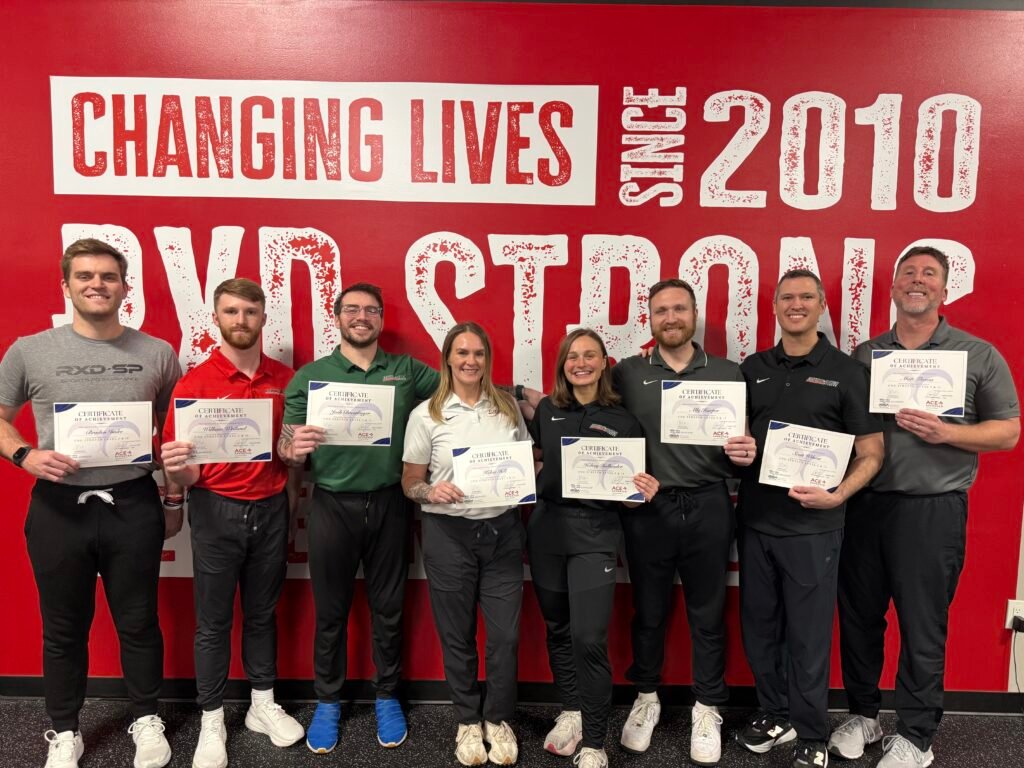
But part-time isn’t the only smart entry point. If you have a clear client acquisition plan and the systems to execute it, hiring full-time from day one is a legitimate strategy — and it works. Gyms like RXD and Contemporary Athlete hired a full-time stretch therapist to launch their program, partnered with CNU Stretch for the coaching, support, and operational systems, and within 30 days of launch were generating enough revenue to cover payroll and return a profit. The difference between that working and not working isn’t the hire — it’s whether you have a real plan behind the hire.
Build the role around a revenue plan, not just around available hours, and the full-time conversation stays honest from day one.
Ready to Build Your Stretch Therapy Team?
CNU Stretch provides everything you need to hire, train, certify, and launch — including done-for-you marketing materials, hiring templates, compensation plan frameworks, and monthly coaching calls with a team that built a six-figure stretch program inside a real gym.
Book a Free Gym Owner Consultation
No pitch. No pressure. A real conversation about what building a stretch therapy team actually looks like for your facility.
Frequently Asked Questions
Should I hire new staff or certify my existing trainers?
In most cases, certifying existing staff is faster, cheaper, and more effective — if they have the capacity and the right disposition. If your team is at capacity or your ambition for the program is large, external hiring is a legitimate path. The decision comes down to two things: how much bandwidth your current staff actually has, and how big you want this program to be.
How long does certification take?
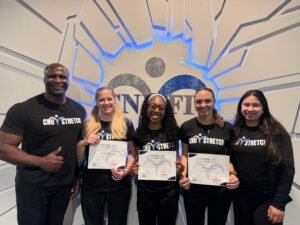
Most staff complete both Level I and Level II within 3 to 4 weeks from enrollment to certification — approximately one week of online coursework followed by a two-day, 14-hour in-person intensive.
How many staff do I need to launch?
You can launch with one certified therapist. But don’t stay there. A program that depends entirely on one person is fragile. Certifying a second staff member as soon as the program gains traction is what creates stability and continuity.
What should I pay a certified stretch therapist?
Starting pay ranges from $18 to $26/hr depending on experience and market. No experience starts at $18 to $21. Kinesiology or training background warrants $20 to $26. Existing stretch certification justifies $22 to $25. Keep total stretch payroll between 25% and 35% of stretch revenue and the business stays healthy.
What’s the difference between a legitimate certification and an online-only course?
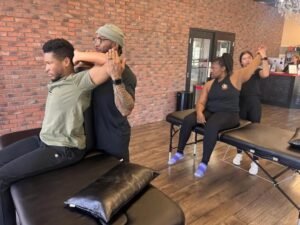
An online-only certification gives your staff information. A legitimate certification gives them capability. The hands-on in-person component — supervised practice on real clients with real-time coaching — is what produces a therapist you can put in front of a paying client on day one. That difference shows up immediately in client outcomes and retention.
What if my candidate has no fitness background at all?
Some of the best stretch therapists come from outside fitness entirely — nursing, caregiving, customer service. What matters most is emotional intelligence, genuine curiosity about the body, and a personal connection to pain or recovery. If those qualities are present, the technical training will stick. Have them observe 10 to 20 hours before making a final hiring decision and watch how they respond to what they see.