Home › Blog › Stretch Therapist Career
Stretch Therapist Career Guide: Income, Paths, and Getting Started
The stretch therapy industry is growing fast — and the career opportunity is real. Here is everything fitness professionals need to know about building a stretch therapist career from first certification to full-time income.
What Do You Need to Become a Stretch Therapist?
To become a stretch therapist, you need a hands-on certification from an accredited program, a foundational understanding of anatomy and assisted stretching techniques, and professional liability insurance. CNU Stretch is approved by NASM, ACE, AFAA, ISSA, and NCBTMB — qualifying you to practice independently or add stretch therapy to an existing fitness business.
In This Article
What Does a Stretch Therapist Do?
Before we talk about income ranges, pricing frameworks, and career paths — it is worth starting where every meaningful career decision should start: why.
Simon Sinek's central argument in Start With Why is that the most fulfilled and effective people in any field don't begin with what they do or how they do it. They begin with why they do it. For a stretch therapist, that question is worth sitting with — because the answer is more powerful than most people expect.
Most people are living with a body that is holding them back. The 45-year-old who stopped running because their hips won't cooperate. The desk worker who wakes up with a stiff back every morning and has just accepted it as normal. The grandmother who can no longer get on the floor to play with her grandchildren. The former athlete who misses feeling like themselves physically. These are not edge cases — they are the majority of adults walking into gyms and wellness facilities every day.
A stretch therapist is one of the few practitioners positioned to actually give those people their mobility back. Not temporarily. Not with medication or passive treatment. Through a systematic, progressive process that retrains how their nervous system responds to movement — and produces results that compound over time. That is the why behind this career. It is a rare combination: work that is financially viable, deeply impactful, and something clients genuinely look forward to every week.
With that foundation in place — here is what the stretch therapist career actually looks like in practice.
A stretch therapist is a trained, certified practitioner who delivers professional assisted and facilitated stretching to clients. Unlike personal trainers who stretch clients at the end of a session, or yoga instructors who lead group movement, a stretch therapist's entire focus is on systematically improving a client's range of motion, reducing muscular tension, and retraining the nervous system's response to lengthening.
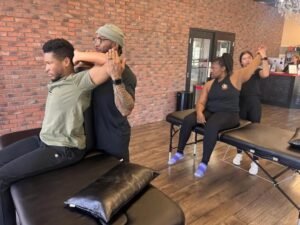
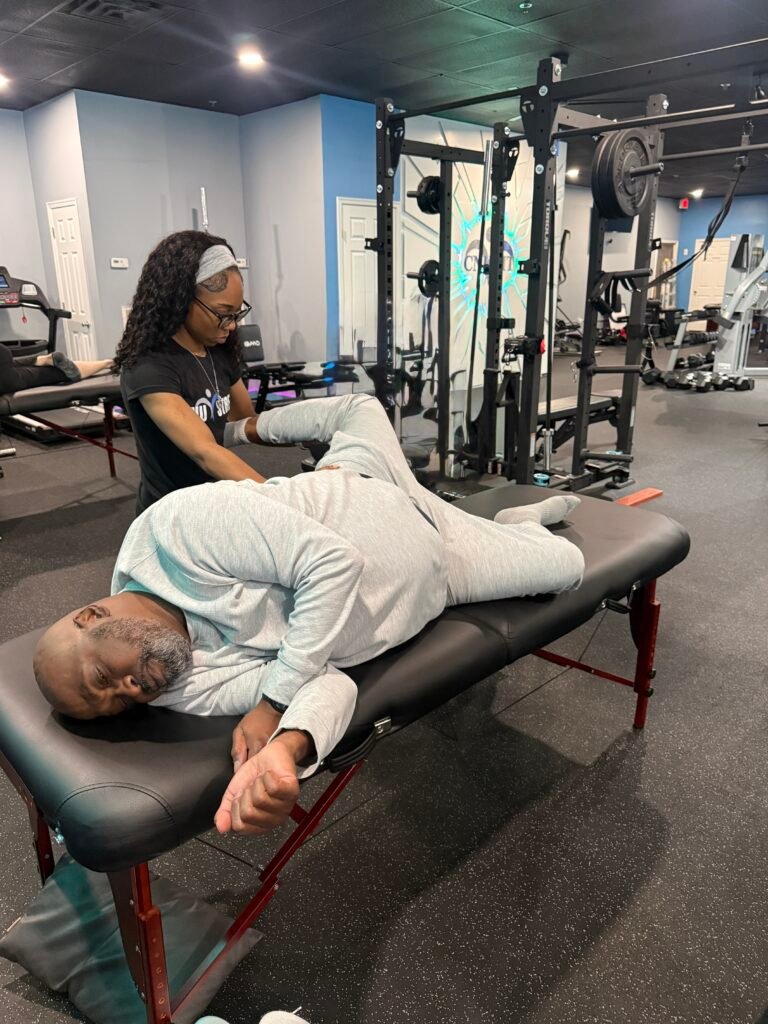
A stretch therapist career centers on one-on-one or small-group sessions, typically delivered on a treatment table. Each session begins with a movement assessment to identify restrictions and postural imbalances. The practitioner then guides the client through a structured sequence of assisted stretches — monitoring their feedback in real time, adjusting depth and pressure accordingly, and progressing the client toward measurable mobility improvements over time.
What distinguishes a skilled stretch therapist from someone who just "does stretching" is the combination of assessment capability, anatomical knowledge, and a structured client communication system. At CNU Stretch, practitioners are trained in the AIS (Awareness, Imbalance & Solution) assessment framework, the GYR (Green-Yellow-Red) client feedback system, and Kinotek AI movement analysis — tools that separate professional stretch therapy from improvised flexibility work.
Stretch therapists work in gyms, fitness studios, wellness centers, chiropractic offices, physical therapy clinics, corporate wellness programs, sports performance facilities, and private practice. The fastest-growing segment is gym owners adding stretch therapy as a standalone revenue service — creating consistent employment opportunities for certified practitioners.
Stretch Therapist Income: What to Expect
Stretch therapist income varies significantly based on employment setting, business model, session volume, and pricing strategy. The range is wide — and how you structure your practice has more impact on your income than almost any other factor.
The income ranges above reflect real-world benchmarks from across the stretch therapy industry. The practitioners who reach the higher end of the independent range share a common characteristic: they built recurring revenue, not just a session calendar. The difference between a stretch therapist earning $45,000 a year and one earning $95,000 is almost never technique — it is business structure.
Research confirms that professionally assisted stretching produces measurably greater outcomes than self-directed stretching — which means clients who experience quality stretch therapy keep coming back. Retention is built into the value of the service. The stretch therapist career opportunity is strong precisely because a well-served client is a recurring client.
How to Price Your Stretch Therapy Services
Pricing is one of the most consequential decisions a stretch therapist makes — and one of the most commonly mishandled. The instinct when starting out is to price low to attract clients. This is a mistake that is very hard to undo.
"Price is a direct reflection of perceived value. It is better to be on the high side with fewer clients than on the low side with more clients — and make the same or even less income."
Here is a practical framework for setting your rates. Use price per minute of service delivered as your baseline metric — it gives you a clean, consistent way to evaluate and compare your pricing regardless of session length.
| Rate Per Minute | 25-Min Session | 50-Min Session | Position |
|---|---|---|---|
| $1.20/min (floor) | $30 | $60 | Absolute low end — not sustainable for most markets |
| $1.60/min | $40 | $80 | Entry-level market rate |
| $2.00/min | $50 | $100 | Strong mid-market position |
| $2.40/min (CNU Fit rate) | $60 | $120 | Upper market — justified by system and results |
| $2.50/min+ | $62.50+ | $125+ | Premium / specialty market |
At CNU Fit, we charge $60 for a 25-minute session and $120 for a 50-minute session. The 50-minute rate is simply double the 25-minute rate — no discount. Longer sessions use more of your time; they should not cost the client less per minute. Keep your pricing structure clean and logical.
Building Recurring Revenue: The Structure That Changes Everything
One-off session bookings — what we call ala carte — are fine for capturing drop-in clients. But you cannot build a stretch therapist career on ala carte revenue alone. The practitioners who build sustainable income do it through recurring monthly memberships or multi-month programs.
At CNU Fit, our 12-month program is priced at $195 per month, which works out to roughly $45 per session at once-weekly frequency. The client pays monthly on autopay — predictable for them, predictable for us. The research and our own experience confirm that clients who commit to once a week or more show the strongest retention and the most significant mobility improvements. That frequency is the sweet spot for both outcomes and income stability.
A few packaging principles worth following:
- Always put expiration dates on packages and promotions. An open-ended 10-pack sitting unused on your books is a liability. A client who bought 10 sessions a year ago and shows up to use two of them is not a recurring revenue client — they are an accounts receivable problem.
- Do not over-discount. Discounts erode perceived value and set a pricing expectation that is hard to reverse. If you run a promotion for a chamber event or community outreach, attach an expiration date and treat it as a client acquisition cost, not a rate cut.
- Shop your local market. Search "stretch therapy" and "assisted stretching" in your area. If there is a StretchLab or StretchZone nearby, call them and ask their rates. Franchises invest in market research — their pricing is a useful benchmark for what your local market supports.
The overhead in this business is remarkably low. You need a massage table, a pillow, a spray bottle, and disinfectant wipes. Clients do not undress. There are no heavy oils. A quality treatment table purchased in 2014 is still in active use today. High margin, low overhead — when the pricing is right, the stretch therapist career math works very well.
Career Paths in Stretch Therapy
A stretch therapist career does not follow one single track. The credential opens several distinct paths — and many practitioners move between them as their business grows.
Employed Studio or Gym Practitioner
Work as a stretch therapist within an existing gym, wellness studio, or fitness facility. Consistent hours, an existing client base, and no marketing overhead — in exchange for a split or hourly rate.
- Best for: those new to the field or preferring structure
- Income ceiling: limited by hours and rate
- Upside: stability, built-in clients, no overhead
Independent Private Practice
Build your own client roster through private sessions, recurring memberships, and word-of-mouth referrals. Full control over pricing, schedule, and service design.
A word of caution here. Michael Gerber's The E-Myth makes a point that is directly relevant to every stretch therapist who considers going independent: being skilled at your craft does not mean you are equipped to run a business built around that craft. The technician who starts a business because they are good at the technical work quickly finds themselves overwhelmed by the entrepreneur and manager roles they never trained for — client acquisition, pricing strategy, scheduling, cash flow, and marketing all land on their plate at once.
Independent private practice is a strong path for stretch therapists who have real business development skills, an existing referral network, or prior experience running a client-facing practice. For those who are primarily practitioners — skilled at the craft but not yet at selling, marketing, or operating a business — starting inside an existing gym or studio first is the smarter move. Build the client skills and the recurring revenue habits before adding the full weight of independent business ownership.
- Best for: practitioners with business development experience or existing client networks
- Income ceiling: high — limited only by capacity and business execution
- Risk: high if business development skills are not yet developed
Add-On to Existing Fitness Business
Personal trainers, massage therapists, and group fitness instructors add stretch therapy as an additional service to their existing client base — often without acquiring a single new client.
- Best for: established fitness professionals
- Income ceiling: significant — serves current clients at premium
- Upside: fastest path to revenue with no new client acquisition
Corporate Wellness & Specialty Markets
Serve corporate clients, athletic teams, senior living communities, or sports performance facilities. Often involves recurring contracts rather than individual session bookings.
- Best for: practitioners with B2B relationship skills
- Income ceiling: very high — contract-based recurring revenue
- Upside: predictable income at scale, high per-engagement value
The fastest path to meaningful stretch therapist income for most practitioners is Path 03 — adding stretch therapy to an existing client base. If you are already working with 15 to 20 training clients, and even half of them add a weekly stretch session, you have just added a significant recurring revenue line without a single new client acquisition effort.
How to Get Started as a Stretch Therapist
The barrier to entry for a stretch therapist career is lower than most fitness specializations — but the quality of your foundation determines the quality of your outcomes. Here is the sequence that produces practice-ready practitioners.
Get Certified Through a Rigorous In-Person Program
The first step is the most important one to get right. Stretch therapy certification requires in-person, hands-on training — not an online course. The touch, leverage, and ability to read tissue response in real time cannot be developed on a screen. Look for a program that covers movement assessment, fascia science, neuromuscular response, and a structured client communication framework. CNU Stretch's Level I and Level II is a two-day in-person intensive with no prerequisites.
Set Up Your Pricing Before You See Your First Client
Do not start with placeholder rates that you plan to raise later. Raising prices on existing clients is harder than pricing correctly from the start. Use the per-minute framework above to set rates that reflect the value of what you are delivering — and build your membership or package structure before you open your calendar.
Run a Launch Practicum
Before you charge for sessions, practice on real people. CNU Stretch's certification includes a supervised practicum where students stretch real clients at the end of the two-day intensive. This closes the gap between knowing a technique and executing it confidently on a paying client — and it generates your first round of testimonials and marketing content on the same day.
Build a Consultation Process
Most stretch therapists who are technically competent still struggle commercially because they do not know how to convert interest into paid commitments. A structured consultation — where you assess the client, identify their specific restrictions and goals, and present a program recommendation — is what turns a curious prospect into a recurring monthly member. This is a learnable skill, and it is one of the most valuable things a stretch therapist career development program can teach.
Pursue Advanced Certifications as You Grow
CNU Stretch's Level I and Level II are taught together as a combined intensive — so most practitioners complete both in a single certification weekend and leave with a full foundation of 65 stretches, the AIS assessment system, and the GYR feedback framework. From there, the path continues. Level III and Level IV add 50+ additional techniques, expanding your protocol library to address more complex restrictions, specialty populations, and performance-specific demands. The practitioners who develop the broadest technical vocabulary are also the ones who can serve the widest client range — and command the strongest rates. Ongoing development matters, but there is no substitute for the clinical intuition that comes from working with diverse clients across different ages, activity levels, and restriction patterns over time.
Mistakes That Keep Stretch Therapists From Earning More
Most of the income gap in the stretch therapist career is not explained by technique or certification — it is explained by avoidable business mistakes. These are the most common ones.
Pricing Too Low at Launch
Starting low to build confidence or attract early clients creates a pricing baseline that is extremely difficult to raise. Clients anchor to what they paid. Price correctly from the start — even if your first few clients are friends or warm referrals.
Selling Sessions Instead of Programs
Ala carte bookings create an unpredictable, feast-or-famine income pattern. Selling monthly memberships or multi-month programs creates the recurring revenue that makes a stretch therapist career financially stable and scalable.
Selling Open-Ended Packages
A 10-pack or 20-pack with no expiration date is a liability on your books — not an asset. Clients who buy packages and use them slowly are not recurring revenue clients. Always attach expiration dates to packages and promotions.
Skipping the Consultation
Walking clients straight into a session without a proper assessment and program recommendation leaves conversion on the table. The consultation is where a one-time visitor becomes a committed monthly client. It is the most financially leveraged 20 minutes in the stretch therapist's workflow.
Getting Certified Online Only
A stretch therapy credential earned entirely online does not produce a competent practitioner — it produces someone who has watched stretching. The hands-on, in-person component of certification is not optional. Clients can feel the difference immediately, and so can your retention numbers.
Ready to Start Your Stretch Therapist Career?
CNU Stretch's Level I certification is a two-day in-person intensive — no prerequisites, CEUs approved through NASM, AFAA, ISSA, ACE, and NCBTMB. Upcoming dates in Delaware, Idaho, Virginia, and Oregon.
View Upcoming Certification DatesFrequently Asked Questions
How much does a stretch therapist make per hour?
Do I need prior fitness experience to become a stretch therapist?
Can I build a full-time income as an independent stretch therapist?
What equipment do I need to start a stretch therapy practice?
Does CNU Stretch certification count toward my continuing education credits?
Keep reading
- The 17-Inch Plate: Why I Failed Two Stretch Therapists Last Weekend (And Why They Thanked Me For It)
- Stretch Therapy vs. Massage Therapy: Key Differences Explained
- Fascia and Flexibility: Why Stretching Is More Complex Than You Think
- How Gym Owners Are Adding $10K–$25K/Month With Stretch Therapy
- What is Stretch Therapy?
- Stretch Therapy Intensity: The Green Yellow Red System | CNU Stretch