Home › Blog › Stretch Therapy for Gym Owners
How Gym Owners Are Adding $10K+/Month With Stretch Therapy
Most gyms are sitting on an untapped revenue stream — one that requires no new equipment, no additional square footage, and no disruption to what they already do. Here's exactly how to add stretch therapy to a gym and what the numbers look like when you do it right.
In This Article
The Opportunity Most Gyms Are Missing
In the fitness business, there are only so many levers you can pull. Training. Nutrition coaching. A pro shop. Challenges and events. Most gym owners have tried most of them — and know the limits. Nutrition clients churn after 90 days. Pro shop revenue has a ceiling. Challenges create short-term spikes, not recurring income.
Stretch therapy is different. And most gym owners haven't touched it yet.
Understanding how to add stretch therapy to a gym the right way — with systems, pricing, and trained staff — is what separates the gym owners generating $10K+ a month from those who tried it and gave up after 90 days. I know this firsthand. I own three CNU Fit locations in Delaware and have been in the fitness industry for 16 years. Stretch therapy quietly became a back-end service we offered starting in 2014 — until 2020, when we built real systems around it and everything changed. That year alone, our stretch revenue went from roughly $7,000 to $44,000. Then to $154,000. In 2024 we generated $250,000 in client stretch therapy revenue. In 2025, $458,625 — from the same gyms, with the same footprint, no new locations.
When I shared those numbers in my gym owners mastermind — a room where the average business was doing $40,000 to $50,000 a month in total revenue — the first question from every person in that room was the same: "Can you teach me how to do that?"
That's why CNU Stretch exists. And this article is the answer to that question.
The Real Revenue Numbers
Let's be direct about what's possible — and what drives it. Stretch therapy revenue in a gym setting is a function of three variables: session pricing, session volume, and retention. When all three are dialed in, the math gets compelling fast.
Across the CNU Stretch licensee network, gym owners who have added stretch therapy to their facilities are generating between $8,000 and $20,000 or more in additional monthly revenue. That range reflects real differences in market size, pricing strategy, and how aggressively they pursued client acquisition in the early months.
What the numbers consistently show is this: stretch therapy clients are among the stickiest clients a gym can have. They book recurring appointments. They refer family members. They add stretch to an existing training membership rather than replacing it. The compounding effect on monthly recurring revenue is unlike anything most gym owners have seen from a service add-on.
"This was an untapped resource that's been under our nose the whole time. We just didn't realize it — until we got our team certified and launched it properly."
CNU Stretch Licensee — Multi-Studio OwnerWhy Stretch Therapy Works as a Gym Revenue Add
Not every service addition makes sense for every gym. The reason stretch therapy works so consistently is that it checks every box that most add-on services fail to clear.
Why They Fall Short
- Nutrition: clients churn after 90 days
- Pro shop: hard revenue ceiling
- Challenges: short-term spikes, not recurring
- Massage: high staff cost, scheduling complexity
- Group classes: cannibalize existing memberships
Why It Works
- Recurring weekly or biweekly bookings
- No new equipment or buildout required
- Complements — doesn't compete with — training
- Certified existing staff in 2 days
- Serves clients who aren't buying training
There is also a demographic angle that most gym owners overlook. The clients most likely to invest in stretch therapy are often not your core training clients. They are the 40+ member who wants to move better. The desk worker with chronic back tightness or knee pain. The former athlete managing the wear and tear of decades of activity. If you operate in the high-performance space, they are the athlete who needs to recover in order to optimize performance. These are people your gym already has — or could attract — who are not currently spending beyond their base membership. Stretch therapy gives them a reason to.
Your members are already looking for this service. The question is whether they're finding it at your gym or driving to a StretchLab down the street. Peer-reviewed research confirms that professionally assisted stretching produces significantly greater mobility gains than self-directed stretching — which means clients who experience it keep coming back.
How to Add Stretch Therapy to a Gym: Step by Step
Knowing how to add stretch therapy to a gym correctly — in the right sequence, with the right infrastructure — is the difference between a service that compounds into a real revenue line and one that fizzles out within the first quarter. Here is the process that CNU Stretch licensees follow to go from decision to generating revenue.
Certify Your Staff
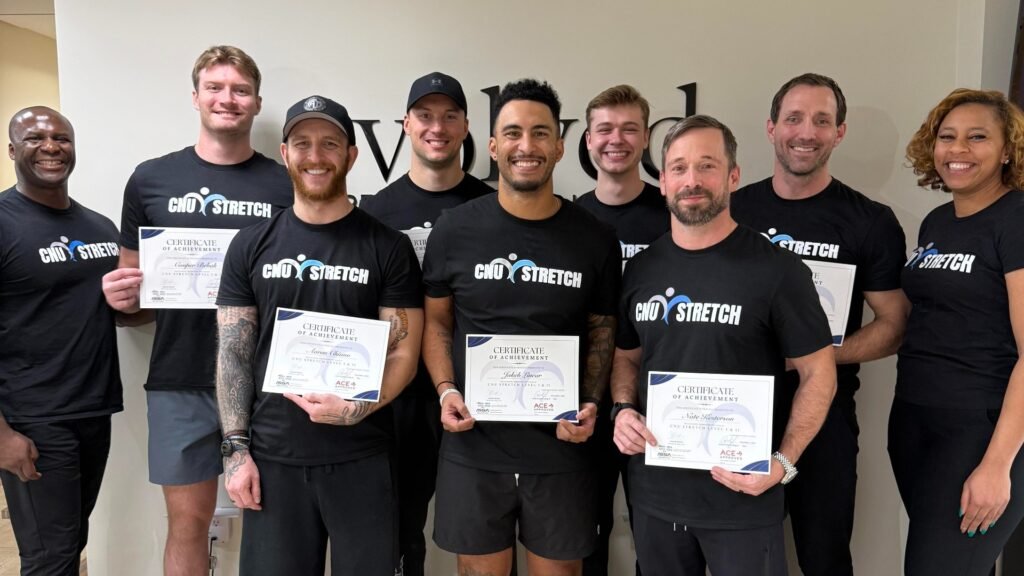
The foundation is having certified practitioners on your floor. CNU Stretch's Level I and Level II certification is a two-day in-person intensive — designed specifically around the reality that gym owners cannot shut their operations down for a week. Most owners certify two to four existing team members initially. The CNU Stretch licensing package includes certification for up to 10 staff members annually.
One thing worth stating plainly: you cannot learn stretch therapy online. The concepts can be studied on a screen — anatomy, fascial lines, neuromuscular science — but the hands-on competence that makes a practitioner effective cannot be developed by watching videos. The touch, the leverage, the ability to read tissue response in real time — these require supervised, in-person practice on real bodies. Any program that certifies stretch therapists entirely online is not producing practice-ready practitioners. That is why every CNU Stretch certification is an in-person intensive, not a digital course.
Set Up Your Pricing and Packaging
Pricing is where most gym owners either undersell themselves or overcomplicate the structure. The core principle: price is a direct reflection of perceived value. When you are new or uncertain, the instinct is to price low. Resist it. It is better to charge more and have fewer clients than to charge too little, work harder, and generate the same or less income.
Here is a practical framework for setting your rates. The floor for stretch therapy should be no less than $1.20 per minute of service delivered. A 25-minute session at that floor is $30 — which is the absolute low end and not a sustainable rate for most markets. A healthy range is $1.60 to $2.50 per minute, which puts a 25-minute session between $40 and $62. At CNU Fit, we charge $60 for a 25-minute session — on the higher end of that range — because the market supports it and the quality of the service justifies it.
For 50-minute sessions, the math is simple: it is the 25-minute rate times two. Do not discount longer sessions. You are not adding value by discounting — you are just using more of your time for less per minute.
To find your local market rate, search "stretch therapy" and "assisted stretching" in your area on Google. If there is a StretchLab or StretchZone nearby, call them. Ask what they charge. Franchises do significant market research — their pricing is a reliable benchmark for what your local market will bear.
On packaging: ala carte sessions are fine for capturing drop-in clients, but you cannot build a recurring revenue business on them. Structure a monthly membership or 6- and 12-month programs to create predictable income. We see the strongest client retention from people who commit to once a week or more — that frequency is the sweet spot for both results and stickiness. If you run promotions or sell packages, always set expiration dates. An open-ended 10-pack sitting unused on your books is a liability, not an asset.
The overhead for this business is minimal — a massage table, a spray bottle, disinfectant wipes, and a pillow. A quality table purchased in 2014 is still in use today. Low cost to operate means your margin on every session is high. Protect it by pricing with confidence.
Run the Launch Practicum
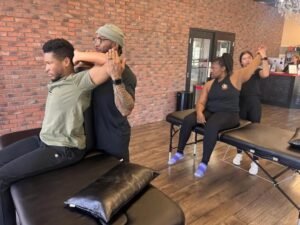
At the end of the certification intensive, each student conducts a supervised 50-minute stretch session with a real client. As the hosting gym, you invite your own members as the practicum clients. This accomplishes two things simultaneously: your team gains real-world competence and confidence before their first paid session, and you walk away with a library of photos, video testimonials, and client reactions you can immediately use for marketing. It is the most efficient gym launch event most owners have ever run.
Deploy the Marketing System
The CNU Stretch licensing package includes done-for-you marketing materials, lead automation integration, and the email scripts and social proof frameworks your team needs to convert your existing member base into stretch therapy clients. You are not starting from zero — you are launching into a warm audience that already trusts you.
Run the Consultation System
One of the biggest reasons certified stretch therapists fail commercially — even with strong technique — is that they don't know how to convert interest into paid clients. The CNU Stretch system includes a structured consultation framework and sales training built specifically for fitness professionals who are not natural salespeople. The consultation is how a prospective stretch client becomes a recurring one.
Measure, Adjust, and Scale
CNU Stretch licensees have access to monthly group coaching calls with CNU Stretch leadership. These calls cover pricing adjustments, marketing performance, staff development, and the operational details that separate gyms generating $5,000 a month in stretch revenue from those generating $20,000. The network effect of having 35+ locations sharing what's working accelerates every licensee's growth curve.
The Revenue Math
Let's put real numbers to what a conservatively run stretch therapy program looks like inside an existing gym. These figures are based on a modest initial setup — one certified practitioner, part-time stretch hours, moderate pricing.
Conservative Monthly Revenue Model
This is before accounting for membership upsells, package pre-sales, or corporate wellness contracts — all of which CNU Stretch licensees have successfully layered onto their core stretch revenue. The model scales cleanly because the marginal cost of each additional session is low: no consumables, no equipment wear, just practitioner time against a treatment table you already own.
The figures above are illustrative benchmarks based on real licensee data — not guarantees. Actual revenue depends on session volume, local market pricing, staff capacity, and client acquisition investment. CNU Stretch provides licensees with the tools, systems, and coaching to pursue the higher end of these ranges — but results are earned through execution.
The CNU Stretch Licensing Model
There are two ways gym owners typically try to add stretch therapy. The first is figuring it out independently — finding a certification somewhere, guessing at pricing, building marketing from scratch, and hoping the economics work out. The second is using a proven system built by people who have already done it at scale.
The CNU Stretch licensing program is the second option. It is not a franchise — there are no territory fees, no mandatory vendor relationships, no royalties, and no restrictions on how you run your business beyond the core CNU Stretch system. What it is is a complete operational infrastructure for launching stretch therapy as a professional, profitable service inside your existing facility.
Staff Certification
Up to 10 staff certified annually through the CNU Stretch Level I & II program. CEUs approved through NASM, AFAA, ISSA, ACE, and NCBTMB.
Done-For-You Marketing
Launch materials, social content templates, and email scripts to convert your existing member base into stretch therapy clients from day one.
Lead Automation
Integration-ready lead capture and follow-up automation for new stretch client acquisition — built to run without manual effort from your team.
Pricing & Packaging Templates
Market-tested session pricing, package structures, and membership models validated across 35+ locations in the CNU Stretch network.
Sample Contracts & Intake Docs
Client intake forms, consent frameworks, and sample service agreements so your operation is professionally documented from the start.
Hiring & Compensation Frameworks
Ad copy, interview guides, and compensation plan templates for owners who need to recruit dedicated stretch therapists rather than cross-train existing staff.
Monthly Coaching Calls
Monthly group coaching calls with CNU Stretch leadership and the broader licensee network — covering pricing, marketing, staff performance, and growth strategy.
Launch Practicum System
A structured practicum at the end of certification that generates your first round of client testimonials, photos, and video content on the same weekend your team gets certified.
The licensing model was built on a simple observation: most certified stretch therapists and gym owners who try to add stretch therapy do not fail because they lack technique. They fail because they lack the business infrastructure to turn a skill into a recurring revenue stream. The licensing package closes that gap.
If you want to understand whether the CNU Stretch licensing model is the right fit for your facility and market, the first step is a strategy call. There is no pressure and no pitch — it is a conversation about your gym, your goals, and whether the model makes sense for your situation.
Ready to Add Stretch Therapy to Your Gym?
Book a licensing strategy call with the CNU Stretch team. We'll walk through your facility, your market, and what a realistic stretch therapy launch looks like for your specific situation.
Book a Strategy Call