Home › Blog › Stretch Therapy vs. Massage Therapy
Stretch Therapy vs. Massage Therapy: What's the Difference?
Two hands-on disciplines. Two very different mechanisms. Understanding the distinction between stretch therapy and massage therapy helps clients choose the right service — and helps practitioners decide which credential to add next.
In This Article
What Each Discipline Actually Is
The confusion between stretch therapy and massage therapy is understandable — both are hands-on, both happen on a treatment table, and both produce feelings of physical relief. But the mechanism, the training, the clinical application, and the outcomes are meaningfully different. Treating them as interchangeable leads clients to choose the wrong service for their needs and practitioners to underestimate what adding the other modality could do for their business.
Massage Therapy
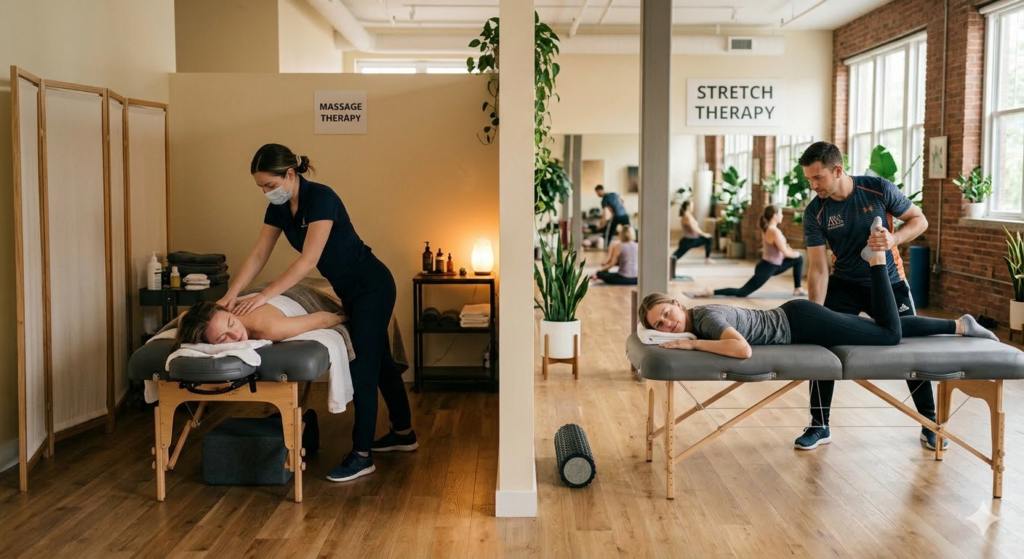
Massage therapy is the manual manipulation of soft tissue — muscles, connective tissue, tendons, and ligaments — using pressure, kneading, friction, vibration, and other hands-on techniques. A licensed massage therapist applies these techniques to reduce muscular tension, promote circulation, support lymphatic drainage, and facilitate recovery from injury or physical stress. Massage works primarily through direct tissue manipulation — the practitioner's hands compress, mobilize, and work tissue while the client remains largely passive.
Massage therapy has a strong clinical application in acute and post-acute care. It is commonly used to manage inflammation, support post-surgical recovery, address scar tissue, and treat specific soft tissue injuries. It is a legitimate medical-adjacent modality with a well-established scope of practice and licensure requirements in most U.S. states.
Stretch Therapy
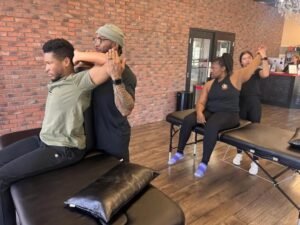
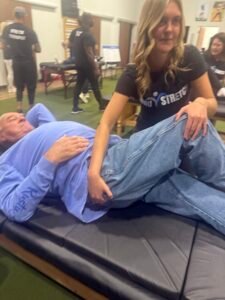
Stretch therapy is a movement-based practice in which a certified practitioner guides the client through assisted and facilitated stretching to improve range of motion, retrain the nervous system's response to lengthening, and address the fascial restrictions that limit functional mobility. Unlike massage, stretch therapy is active and participatory — the client is engaged throughout the session, providing real-time feedback and contributing to the technique through controlled movement and breath.
At CNU Stretch, every session begins with a structured 10-point on-table assessment before any stretching begins. This assessment identifies which fascial lines are restricted, where postural imbalances originate, and what the session should specifically address. No two clients receive the same session — the protocol is built around what the assessment reveals, not a generic routine applied the same way to everyone.
Side-by-Side Comparison
How It Works
- Manual pressure and soft tissue manipulation
- Client is passive — practitioner does the work
- Works directly on muscle and connective tissue
- Promotes circulation and lymphatic flow
- Strong clinical use for acute injury and inflammation
- Requires licensure in most U.S. states
- Often focuses on specific problem areas
- Outcome: tension reduction, tissue recovery, relaxation
How It Works
- Assisted and facilitated movement techniques
- Client is active — feedback and engagement required
- Works on fascial lines, joint mobility, and nervous system
- Retrains neuromuscular response to range of motion
- Best for chronic restriction, mobility, postural correction
- Requires certification — no state licensure in most cases
- Structured — 10-point on-table assessment before every session
- Outcome: improved range of motion, postural change, functional mobility
When Massage Therapy Is the Right Choice
Massage therapy is particularly well-suited to situations where the body needs direct tissue intervention — especially in the presence of acute injury, significant inflammation, or post-surgical recovery. In these contexts, massage's medical-adjacent scope makes it the more appropriate choice.
Acute injuries and active inflammation are contraindications for deep stretch therapy. When a client presents with a recent muscle tear, significant joint swelling, acute nerve irritation, or post-surgical tissue, massage therapy — under appropriate medical guidance — is typically the correct intervention. Stretch therapy is most appropriate once the acute phase has resolved and the goal shifts to mobility restoration and functional movement.
Massage therapy excels in the following situations:
- Acute soft tissue injury — strains, sprains, and muscle tears where controlled circulation and lymphatic support accelerate healing
- Post-surgical recovery — scar tissue management, circulation support, and edema reduction
- Active inflammation and swelling — gentle lymphatic drainage reduces fluid accumulation and supports the body's healing response
- Stress-related tension — the parasympathetic nervous system response triggered by massage is particularly effective for stress-driven muscular tension
- Trigger point work — direct manual pressure on hyperirritable spots in muscle tissue is more effectively addressed through massage than stretching alone
When Stretch Therapy Is the Right Choice
Stretch therapy is most effective when the goal is to build functional range of motion, correct postural patterns, and retrain the nervous system's long-term response to movement over a progressive series of sessions.
Massage Therapy Is Better For
- Acute or recent injury recovery
- Active swelling or inflammation
- Post-surgical tissue management
- Stress-driven muscular tension
- Trigger point release
- Relaxation and parasympathetic response
Stretch Therapy Is Better For
- Chronic tightness and restricted movement
- Postural correction over time
- Nervous system re-education
- Athletic performance and recovery
- Functional daily mobility goals
- Progressive, measurable range-of-motion improvement
The Physical Toll: What Each Demands of the Practitioner
This is a dimension of the stretch therapy vs. massage therapy conversation that rarely gets discussed openly — but it matters enormously for practitioners making career decisions and for massage therapists considering what to add to their practice.
Massage therapy is physically demanding work. Deep tissue massage requires sustained application of significant manual force — through the thumbs, forearms, elbows, and hands — across sessions that run 60 to 90 minutes. Practitioners typically work multiple sessions per day, five or more days per week. The cumulative physical toll is significant and well-documented in the profession: repetitive strain injuries, thumb and wrist joint deterioration, shoulder problems, and chronic upper body fatigue are common among experienced massage therapists. Many LMTs find themselves physically unable to sustain full caseloads by their late thirties or forties — not because they lost interest in the work, but because their bodies gave out from the sustained mechanical demand.
Practitioner Body Load
- High sustained manual force through hands, thumbs, forearms
- Repetitive strain risk — wrists, thumbs, shoulders
- Deep tissue work significantly raises fatigue per session
- Joint deterioration common at high session volume
- Career longevity is a documented concern in the profession
- Many practitioners reduce hours or exit the field mid-career
Practitioner Body Load
- Lower sustained force — leverage and positioning do the work
- Body mechanics trained explicitly in certification
- Significantly lower repetitive strain risk
- More sustainable at high daily session volume
- Fatigue is manageable across a full day of sessions
- Many massage therapists add stretch to extend career runway
Stretch therapy is structurally different. Techniques use leverage, positioning, and the client's active participation to achieve depth — rather than requiring the practitioner to generate sustained manual force. A trained stretch therapist can deliver multiple sessions in a day without the same physical cost that equivalent hours of deep tissue massage would impose. For massage therapists thinking seriously about their long-term career sustainability, this is not a minor consideration.
Why Massage Therapists Are Adding Stretch Therapy Certification
Massage therapists are among the fastest-growing segment seeking stretch therapy certification — and when you understand both disciplines, the reasons are clear.
A Complementary Modality, Not a Competing One
Stretch therapy does not replace massage — it extends what a massage therapist can offer. Many clients who book 60-minute massages are strong candidates for adding a weekly stretch session. The LMT who can offer both serves more of the client's physical needs and increases per-client revenue without acquiring new clients.
Reduced Physical Demand Per Session
For massage therapists managing the cumulative body toll of deep tissue work, stretch therapy provides a lower-force service to fill parts of the schedule where the physical cost of additional massage would be too high. Many practitioners strategically alternate modalities throughout the day — extending their working hours and career longevity in the process.
Movement-Based Results That Massage Cannot Produce
Massage therapy excels at soft tissue recovery and relaxation. It is less effective as a tool for building functional range of motion and retraining nervous system movement patterns over time. Stretch therapy addresses the mobility dimension that massage clients are often asking about — and produces progressive, measurable results that deepen client loyalty and retention.
Structured Assessment Adds Clinical Depth
The CNU Stretch 10-point on-table assessment gives massage therapists a structured movement evaluation framework that complements their existing clinical knowledge. Rather than working solely from the client's verbal description of where they hurt, practitioners learn to identify fascial restrictions and movement compensations systematically — and design sessions around what the assessment reveals.
CEUs Through NCBTMB — Directly Applicable
CNU Stretch's Level I and Level II certification is approved for 15.5 continuing education units through NCBTMB — one of the primary credentialing bodies for licensed massage therapists. Massage therapists can meet renewal requirements while simultaneously adding a new revenue-generating modality to their practice.
How Stretch Therapy and Massage Work Together
The most accurate framing of stretch therapy vs. massage therapy is not a competition — it is a continuum. These modalities address different phases and dimensions of physical wellness, and clients who have access to both — used at the right times — typically experience better outcomes than those relying on either alone.
A client recovering from a hamstring strain might begin with therapeutic massage in the acute phase — supporting tissue healing, reducing inflammation, and restoring circulation. As the acute phase resolves, stretch therapy becomes the appropriate tool: systematically restoring range of motion along the posterior fascial line, retraining the nervous system's tolerance for lengthening, and addressing the compensatory patterns the injury created in adjacent areas.
For the wellness client with no acute injury — the desk worker with chronic postural restriction, the recreational athlete managing accumulated training tension, the 50-year-old who wants to move like they did at 35 — both modalities serve different but complementary purposes. Massage addresses tissue quality and recovery. Stretch therapy builds functional mobility and the movement capacity that turns short-term relief into lasting physical change.
"The clients who get the best long-term results are the ones who use both — massage when the body needs recovery and tissue work, stretch therapy when the goal is building and maintaining functional mobility."
Add Stretch Therapy to Your Practice
CNU Stretch's Level I and Level II certification is a two-day in-person intensive — open to massage therapists, personal trainers, and fitness professionals. NCBTMB approved for 15.5 CEUs. Upcoming dates in Delaware, Idaho, Virginia, and Oregon.
View Certification Dates