When the Client Says Ow Before You Feel the Stretch: Dural Tension, Nerve Flossing and When to Refer
By Evans Armantrading, CEO of CNU Stretch · Stretch Therapy Education
From The Stretch Movement, Episode 4, with Dr. John Dabbs, D.C., and Dr. Debbie Dabbs, PT, DPT. Catch the episode recap and the arthrokinematics post first if you haven’t yet.
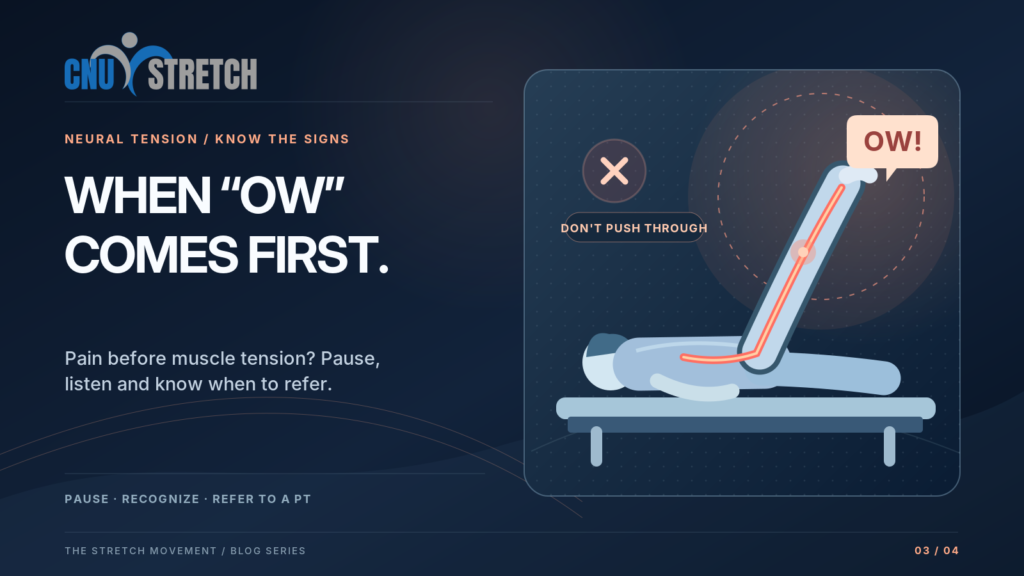
Picture this. You’ve got your client on the table for a hamstring stretch. You lift the leg, and you’re still way down low. You haven’t even felt the muscle start to take up tension yet. And the client says, “Ow. Ow.”
What do you do?
A lot of stretch therapists push through it. “You’re just tight. Breathe into it.” And that’s exactly the moment Dr. Debbie Dabbs, a doctor of physical therapy with more than 20 years in practice, wants every one of us to stop.
“If they say ow when you’re way down low, and you don’t feel any tension from a therapist standpoint, you know something is not right. Like the patient’s feeling pain, but you’re not feeling the stretch. There’s some dural tension in there.”
That one moment separates a good stretch therapist from a great one. So let’s dig in: what the dura is, what dural tension feels like, what nerve flossing is, the red flags, and when to refer to a physical therapist. And I’ll finish with the part Debbie made sure we heard: you can still stretch this client.
What is the dura, and what is dural tension?
Let’s go back to anatomy class for a minute, fifth-grade style.
Your brain and spinal cord are wrapped in three protective layers. The outermost and toughest one is the dura mater. That’s Latin for “tough mother,” and it fits. Think of it as a strong, flexible sleeve around the spinal cord. As the nerves branch out of the spine to your arms and legs, that protective covering continues along the nerve roots.
Here’s the part most people never think about: your nervous system has to move. It’s one continuous system from your brain to your toes. Every time you bend forward, turn your head, straighten your knee or point your foot, your nerves have to slide and lengthen through the tissues around them. When you lift a straight leg, the sciatic nerve gets longer and slides, all the way up into the low back where its roots leave the spine.
In a healthy body, that sliding is smooth and you never feel it.
Dural tension, which clinicians also call neural tension, is what happens when that system gets irritated or stuck. Maybe a disc is bulging toward a nerve root. Maybe there’s inflammation or narrowing where the nerve exits the spine. Maybe there’s scar tissue from an old injury or surgery. Now, when you put the nervous system on a stretch, it doesn’t slide the way it should, and it fights back with symptoms.
That’s why Debbie connected the “ow” moment to the low back: “They are probably having some low back dysfunction.” The pain shows up in the leg, but the source can be at the spine.
What does nerve pain feel like compared to muscle? Clients usually describe it differently:
- Sharp, burning, electric or “zinging”
- Shooting or traveling down the leg (or down the arm for the neck), sometimes past the knee
- Tingling, pins and needles, or numbness
- Pain that shows up early in the range, before you feel any muscle tension
Clinicians test for this with special tests. For example, adding a chin tuck or pulling the toes up during a straight-leg position puts more tension on the nervous system without changing the hamstring much. If the symptoms change, it points to the nerve. You don’t need to run those tests. That’s the physical therapist’s job. But listen for it. If your client tells you “it zings worse when I tuck my chin” or “it shoots down when my foot comes up,” that’s not a tight hamstring talking.
A good deep stretch vs. a nervy pain: Dr. Debbie’s framework
I loved how Debbie put this, because it’s so practical. At CNU Stretch, we use our Green, Yellow, Red system so the client controls the intensity of every stretch. Green, they’re just beginning to feel it. Yellow is a nice, deep stretch, and that’s what we’re looking for. Red means back off. Debbie’s point is that the color is only part of the picture. She wants us to read the body too:
“Every stretch therapist needs to have a good idea of what’s normal. What’s a normal stretch? And yeah, the patient or the client can say red, yellow, green, and that’s fine. But what is their face looking like? Does it feel like a springy feel, or does it feel like a hard end feel?”
And the question I want you to ask yourself on every rep:
“What causes them to stop the stretch before the therapist actually feels the point of tension?”
She talked about knowing the difference between “the bony block, versus a stretchy block, versus a painful stretch, versus a good stretch. Good deep stretch.” That’s what we want.
Here’s that framework on the table:
| What you’re feeling | What you notice in your hands | What the client says or shows | What to do |
|---|---|---|---|
| Good deep stretch (our yellow) | Tension builds gradually, springy at the end | “That’s a good stretch.” Relaxed face, steady breathing | Keep going. This is the yellow zone, the goal |
| Muscle guarding or spasm | The muscle grabs or jumps before the end of the range | Bracing, holding the breath, pulling away | Back off, slow down, breathe, try again lighter |
| Bony or hard block | Abrupt, hard stop with no give | “It’s pinching” or a deep ache in the joint | Don’t force it. Note it, and see the arthrokinematics post |
| Nervy pain (dural or neural tension) | Little or no tension yet | “Ow” early, burning, zinging, tingling, pain shooting down the leg | Stop that stretch. Don’t stretch through it. Refer to a PT |
That last row is the whole point of this article. When the pain comes before the tissue tension, the problem usually isn’t the muscle you’re stretching.
On the show I said it this way: if you’re not even in a full load for a good quality stretch, and they’re going through the symptoms of pain, that’s telling you there’s something neurological. And at that point a stretch therapist should know, “We’ve just hit the end of my scope.”
Nerve flossing: what it is, and why it belongs to the PT
We went down this road a little on the episode, so let’s finish the thought.
Nerve flossing is the everyday name for what physical therapists call neural mobilization or neurodynamics. The idea is to help an irritated nerve slide through the tissues around it again, the way dental floss slides between your teeth. Instead of holding a long static stretch on the nerve, the movements are gentle and rhythmic.
There are two main kinds:
- Sliders (or glides): you lengthen the nerve at one end while you shorten it at the other, so the nerve slides back and forth without building much tension. For the sciatic nerve, that might mean straightening the knee while tipping the head back, then bending the knee while bringing the chin down. Gentle, smooth, no big pull.
- Tensioners: you lengthen the nerve at both ends at the same time, which puts more load on it. These are more aggressive and are usually used later, when the nerve is less sensitive.
Physical therapists choose between them, set how many reps and how far to go, and progress the program after they’ve evaluated the client. That dosage matters. An irritated nerve can flare if it’s pushed too far, too fast or too often.
That’s why I said it plainly on the show:
“Nerve flossing is not within our scope of practice.”
Sometimes a client catches a nerve in one position, and a small adjustment to the leg position clears it right up. That’s fine. But if you’ve adjusted a couple of times and it keeps coming back, you’re no longer dealing with a muscle you can stretch. You’re dealing with a nervous system that needs a clinician’s evaluation and plan.
Here’s the mindset I want you to have. Nerve flossing isn’t a technique for you to borrow. It’s a reason to have a great physical therapist in your phone.
Red flags: when not to stretch until a doctor says so
I asked the Dabbses straight out: when is professionally assisted stretching not what someone should do?
Debbie started with the client’s response:
“If they have an adverse response, if they’re in a lot more pain after stretch, then there has to be some modifications or discontinuation until they’re ready for it again.”
She also mentioned clients with extreme mobility limitations, like struggling to roll from their back to their side, and skin issues. Then Dr. John Dabbs added the medical red flags:
“DVTs, that abnormal swelling that is just not normal for that patient… strong calf pain when we’re getting ready to move them or as they’re walking. If they’re having difficulty breathing when they’re laying down… congestive heart, those kinds of things. And those are where we say, hey, let’s get a medical eval first.”
His reasoning is simple. Stretch is great because it increases circulation and moves fluid, “but we’ve got to make sure that we’re doing it in the safest capacity and what’s best for the patient.” If there could be a blood clot in the leg, the last thing you want to do is move it.
Here’s your checklist.
Stop and get a medical evaluation first (what the Dabbses flagged):
- A lot more pain after a session than before
- Unusual swelling in one leg, especially with calf pain, warmth or redness (possible DVT)
- Strong calf pain when you start to move the leg, or when they walk
- Shortness of breath when lying flat, or new swelling in both legs (possible heart issue)
- Skin that is broken, infected or very fragile in the area you’d be working
Call 911 or go to the emergency room now (general medical guidance, not from the episode):
- New numbness in the groin, inner thighs or “saddle” area
- New trouble controlling the bladder or bowels
- Leg weakness that is getting worse, or a foot that starts to drop
- Sudden shortness of breath or chest pain
The first three on that emergency list can be signs of cauda equina syndrome, a compression of the nerve roots at the bottom of the spine that needs urgent surgery. The fourth can mean a blood clot has moved to the lungs. These are rare, but every person who puts hands on clients should know them cold.
When to refer to a physical therapist
Debbie was clear that a referral is good care, not a failure. A consult with a therapist “might be in order,” she said, and “I think the patient would appreciate you referring them out, or making a recommendation for someone at a different level to look at the patient.”
Refer your client to a physical therapist when:
- They say “ow” before you feel tension. Pain early in the range, with the muscle still slack, is Debbie’s number one sign.
- The pain sounds like a nerve: burning, electric, zinging, shooting, tingling or numbness, especially if it travels down the leg or arm, or past the knee.
- Symptoms change with a body part far from the stretch, like a chin tuck or the foot coming up during a leg stretch.
- Small position changes stop working. You’ve adjusted the leg a couple of times and the nervy pain keeps coming back.
- They feel worse after sessions, not better, or their range is going down instead of up.
- They notice weakness: a foot that catches, a knee that buckles, a grip that’s weaker.
- They have a history of a disc herniation, stenosis, sciatica or back surgery and their symptoms are changing.
One practical note from the episode. I asked whether a PT could assess someone virtually, say, a client in California. Debbie explained that telehealth physical therapy generally has to follow state licensure, so for her, the patient has to be in North Carolina. So build relationships with physical therapists in your state, and in your town.
How to make the referral:
- Stop the stretch that caused it, finish the session with safe areas, and tell the client what you noticed in plain words: “That pain showed up before I even felt the muscle stretch. That tells me it might be a nerve, and I want a physical therapist to take a look.”
- Write down exactly what happened: the position, the side, how far into the range, what they felt and where.
- Give them a name, not just “go see a PT.” Know who you’re sending them to before you need it.
You can still stretch them
This is the line I want every stretch therapist to remember from this episode. When I said, “at that point, find a physical therapist,” Debbie jumped in:
“Well, I don’t think stretch needs to be… Stretch doesn’t need to be discontinued. It’s always a great adjunct, and there’s plenty of other things to stretch.”
And then:
“Stretches can still continue, no matter what, through those things.”
That’s a doctor of physical therapy telling you that a client with nerve symptoms, or other conditions they’re being treated for, can still be your client. It’s a matter of stretching different areas and working with the practitioner, so the client still gets an effective stretch.
Here’s what that looks like in practice:
- Stay out of the positions that load the irritated nerve. For a sciatic-type issue, that often means skipping straight-leg hamstring work and long-sitting positions on that side, and never pairing a leg stretch with a chin tuck.
- Work everything else. Hip flexors, quads, calves, the opposite side, the thoracic spine, the chest, the shoulders, the neck. There’s plenty of other things to stretch.
- Stay below the symptoms. Any burning, tingling or zinging is your signal to ease off, every time.
- Ask the PT what they want. “What should I avoid? Is there anything you’d like me to focus on?” When the PT starts nerve glides, ask how your sessions can support them.
- Keep your notes and keep them in the loop. You see this client more than anyone. Your observations are valuable.
- Keep them moving. As Dr. John said, stretch “increases circulation” and “turns on the nervous system,” and it also helps calm it down. Movement is good medicine.
The client doesn’t have to choose between their PT and their stretch therapist. They get both, and they get better faster because the people taking care of them are talking to each other.
Humble enough to stop
I’ll leave you with what I said on the episode, because I believe it with my whole heart:
“Yes, our goal is to create revenue. But you don’t start in wellness with the starting goal of making money. The starting goal: help the patient, help the client. Eventually you’ll help enough people and you’ll create what you want.”
That means being humble enough to say, “I’m not going to stretch through this.” Finish the session with what’s safe. Make the recommendation. Stay in their corner.
The clients will remember that you knew the difference. The physical therapists in your town will remember that you sent them the right patients, at the right time, with good notes. That’s how referrals start flowing both ways.
Thank you to Dr. Debbie Dabbs of ProTherapy Concepts and Dr. John Dabbs of Eden Chiropractic for teaching us something every stretch professional should know.
Next up: if chiropractors and PTs handle the joint and the nerve, are they competition for stretch therapists? Read Are Chiropractors and Physical Therapists Competition for Stretch Therapy?
Want to train your hands to feel the difference between a good deep stretch and a red flag? That’s what the CNU Stretch Certification is built for. And join The Stretch Movement on Facebook to keep the conversation going.
This article is for education. It isn’t medical advice, and it doesn’t replace an evaluation by a licensed physical therapist, chiropractor or physician. If you or a client has any of the emergency signs above, call 911.