Still Tight After Stretching? It Might Be the Joint: Arthrokinematics for Stretch Therapists
By Evans Armantrading, CEO of CNU Stretch · Stretch Therapy Education
From The Stretch Movement, Episode 4, with Dr. John Dabbs, D.C., and Dr. Debbie Dabbs, PT, DPT. If you missed the episode recap, start here.
You know this client. Every stretch therapist has one.
They come in twice a week. They do their homework. They tell you, “Evans, I’m stretching every night.” And every single session, that same right hamstring is tight again. You work it, it opens up, they feel amazing, and a week later you’re right back where you started.
Most of us were trained to think the answer is more stretching. Hold it longer. Go a little deeper. Add another set at home.
But on Episode 4 of The Stretch Movement, Dr. John Dabbs, a chiropractor who’s been practicing for 30 years, told us something every stretch therapist needs to hear:
“It can also mean that we’re having arthrokinematic restrictions. So the muscle integrity may still be there, but they may have something underlying, underneath that muscle integrity, that may be dysfunctional also.”
In other words: sometimes it isn’t the muscle. Sometimes it’s the joint.
So let’s break it down like we’re in the fifth grade. What arthrokinematics is, how stretch affects it, the signs you’re dealing with a joint and not a muscle, and when it’s time to bring in a chiropractor.
What is arthrokinematics?
There are two kinds of motion happening every time a client moves.
Osteokinematics is the motion you can see. The thigh bone swings up when you raise a leg. The arm lifts overhead. Flexion, extension, rotation. This is what we measure when we say someone has “90 degrees of hip flexion.”
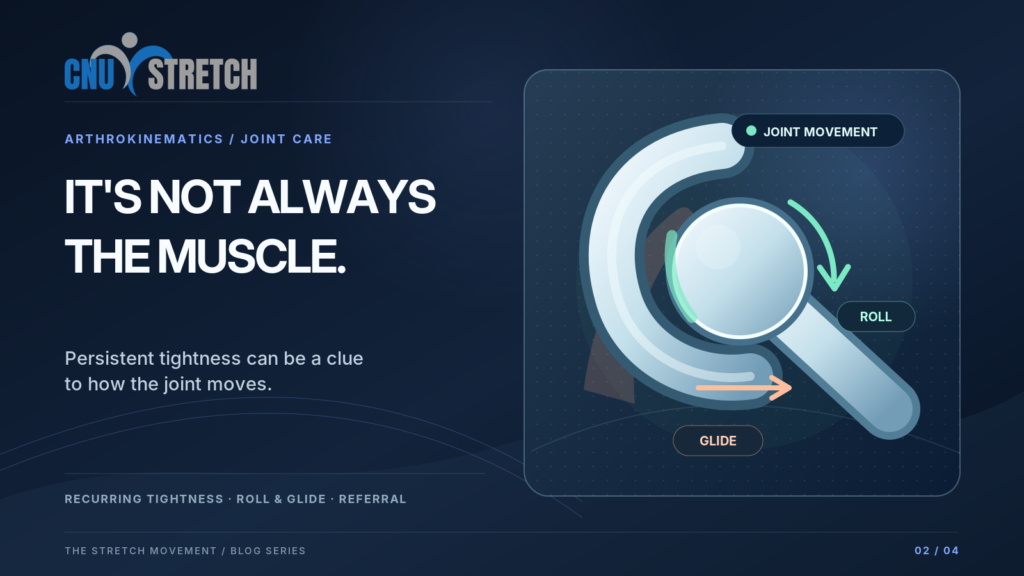
Arthrokinematics is the motion you can’t see. It’s what the joint surfaces do inside the joint while the bone swings. “Arthro” means joint, “kinematics” means motion. Joint motion.
Inside every joint, the surfaces move in three basic ways:
- Roll: one surface rolls across the other, like a tire rolling down the road. New spots on one surface meet new spots on the other.
- Glide (or slide): one surface slides across the other, like a tire skidding on ice. One spot on one surface touches new spots on the other.
- Spin: one surface turns in place, like a top spinning on a table.
In a healthy joint, these happen together. When you bend your knee or lift your arm, the joint surfaces roll and glide at the same time, so the bones stay lined up and the joint doesn’t jam. If a joint only rolled, the bone would roll right off its partner.
There’s also something called joint play: the small amount of give a healthy joint has that you can’t create on your own, but a practitioner can feel when they move it for you. Think of the play in a well-oiled hinge.
Here’s why this matters for us. When that roll and glide get restricted, the visible range of motion gets restricted too. A stiff joint capsule, swelling, degeneration like the osteoarthritis John mentioned, or a facet joint in the spine that isn’t gliding the way it should can all stop the bone short. And when the bone stops short, guess what the client feels?
“I’m tight.”
The muscle gets blamed for a problem that lives in the joint. And no amount of hamstring stretching is going to make a stuck joint glide.
What Dr. John taught us about “protection mode”
John walked us through the exact client I described at the top:
“If we have somebody with a chronic low back, and we’re stretching their low back, stretching their low back, stretching their hamstrings, and they’re still chronically tight, well, we’ve got to dig a little bit deeper.”
Then he asked the questions a great clinician asks:
- Is it really the hamstring?
- Is it ankle mobility, changing the way they walk?
- Is there a little disc involvement in the low back?
- Is there degeneration in the facet joints that’s not allowing the spine to move correctly?
And here’s the line that changed how I teach this:
“…which causes the hamstrings to start to feel tight, because now they’re in a protection mode.”
Think about that. The hamstring isn’t the problem. The hamstring is the bodyguard. When something deeper isn’t moving right, the body tightens the muscles around it to protect it. You can stretch the bodyguard all day long, but as soon as the client stands up and walks out, the bodyguard goes right back on duty.
John also reminded us that the body works as one chain, starting at the feet. “Everything is set up off a kinetic chain,” he said, and every time we move, “it runs straight up our body.” An old ankle sprain that stopped absorbing shock can show up as right knee pain, then left hip pain, “zig-zagging its way up the kinetic chain trying to find a pressure release.” That’s why, for him, “the starting point is always going to be the foot.” He watches people walk into the treatment room, walk toward him and walk away from him before he ever puts a hand on them.
His simple rule for us on the table:
“If we keep finding that same hamstring is tight, and they’re reassuring us, ‘Hey, I’m doing my stretching at home’… there’s probably something else going on in there when it’s asymmetrical.”
If the right side doesn’t match the left, and it keeps coming back, that’s not a stretching problem. That’s a clue.
How stretch affects the joint, and why chiropractors want patients stretched first
Now here’s the good news for stretch therapists: stretch and joint care are not either/or. They work together.
Muscles move the bones. Every muscle you stretch crosses at least one joint, and when those muscles are guarded and tight, they pull on and compress the joints they cross. Calm the muscles down, and the joint has room to move.
I asked John whether he prefers patients stretched before or after an adjustment. His answer:
“I like my patients to be stretched first. Again, it increases body circulation for them. It starts to loosen up the arthrokinematics that we were talking about. It starts to loosen up some of the joint structures… makes them a little bit more compliant on the table.”
He added that after a stretch session, “a lot of their joint receptors are already woken up,” so he doesn’t need as much other therapy before he works. As a full-spine practitioner, when he puts someone in a side-lying position to work on their low back, they’ve already been stretched in that position. “So I don’t have the muscle restrictions that are going to stop me from delivering a good adjustment.” And it’s more comfortable for the patient.
I summed it up on the show like this: adjustments go easier, and some of them may hold longer, because the tissues aren’t fighting back.
So what’s the line between our work and theirs?
- We work on the soft tissue: lengthening muscles, calming the nervous system, improving circulation and comfort, and noticing patterns across sessions.
- The chiropractor (and the physical therapist) diagnoses and treats the joint itself: assessing joint play and alignment, and mobilizing or adjusting the joints that aren’t gliding.
That difference matters. A stretch therapist doesn’t diagnose a facet problem or try to force a stuck joint to move. Our job is to recognize when the pattern points to the joint, keep the client comfortable, and get them to the right person.
Signs it’s the joint, not the muscle
Your hands are your best assessment tool. Dr. Debbie said every stretch therapist needs to know what normal feels like, and she asked the question I want you to ask on every rep: “Does it feel like a springy feel, or does it feel like a hard end feel?”
Here’s how I teach the difference:
| What you notice | Usually muscle | Could be the joint |
|---|---|---|
| How the end of the range feels | Gradual, springy, builds slowly as you go | Sudden, hard or bony stop, like hitting a wall |
| Where the client feels it | A pull in the belly of the muscle | A pinch, block or ache deep in the joint (the front of the hip, deep in the shoulder, the low back) |
| What the client says | “That’s a good stretch” | “Something’s catching” or “It’s pinching” |
| Over a few sessions | Range improves and holds | Range opens on the table, then it’s back the next visit |
| Right vs. left | Similar, or improving toward even | One side stays stuck while the other is normal |
| Sounds and feelings | None | Clicking with pain, catching, locking, or the joint “giving way” |
One of these on its own doesn’t mean much. Bodies are different, and a client can be both tight and restricted. But when you see two or three of them stacking up, especially the hard stop and the same side coming back every week, that’s the pattern John was talking about.
Take notes every session. Write down the side, the range, the end feel and what the client said. That record is what makes you valuable to a chiropractor, because you’re seeing this client more often than anyone else.
When to refer to a chiropractor
On the show I said it plainly: there’s nothing wrong with recognizing “I can’t do this part, and we should refer out.” That’s good due diligence as a professional. One could support the other.
Consider referring your client to a chiropractor when:
- The same tightness keeps coming back after about a month of consistent sessions plus home stretching. John’s example was a client seen once or twice a week for a month with the same hamstring tight every visit.
- You feel a hard, bony end feel or the client describes a pinch or block in the joint instead of a stretch in the muscle.
- One side stays restricted while the other side is normal, and it isn’t changing.
- The joint catches, locks or gives way, or clicks with pain.
- Stiffness in the neck or back limits daily life, like turning to check a blind spot or bending to tie a shoe, and stretch only helps for a day.
- The pattern points up or down the chain: an old ankle sprain, a foot that turns out, a knee and the opposite hip bothering them, or a tight jaw with a forward head.
- The client asks whether something is out of alignment. Don’t guess. Get them to someone who can assess it.
And some things go past a chiropractor straight to a medical provider: a recent fall or accident, pain that’s getting worse instead of better, pain at night that doesn’t change with position, unexplained weight loss or fever with back pain. When in doubt, refer.
How to refer like a pro:
- Tell the client what you noticed, in plain language: “Your right hip keeps stopping hard at the same spot, and stretching isn’t changing it. I’d like a chiropractor to look at how that joint is moving.”
- Send your notes with them: side, range, end feel, what’s changed over your sessions.
- Build the relationship before you need it. Introduce yourself to two or three chiropractors in your area, and offer to stretch their patients before adjustments the way the Dabbses do.
You’re not losing a client when you refer. You’re becoming the professional they trust.
You can still stretch them
This is the part I don’t want anyone to miss. A referral is not a goodbye.
When I asked about the edge of our scope, Dr. Debbie Dabbs, a doctor of physical therapy with more than 20 years of experience, said this:
“I don’t think stretch needs to be discontinued. It’s always a great adjunct, and there’s plenty of other things to stretch.”
And she followed it up: “Stretches can still continue, no matter what, through those things.”
So what does that look like when a client has a joint issue, or arthritis, or other conditions the chiropractor is managing?
- Stretch around it, not into it. If the right hip joint is being treated, you can still work the calves, the opposite hip, the thoracic spine, the shoulders and the neck. The client still gets a great session.
- Change the position and the intensity. Shorter range, more support, less load on the joint that’s being treated.
- Coordinate the timing. John likes patients stretched before the adjustment, ideally the same day. Some of his patients alternate every two weeks between chiropractic and stretch.
- Ask the practitioner what they want. “Is there anything you want me to avoid? Anything you want me to focus on?” That one question builds more trust than any brochure.
- Keep the client in your rhythm. Movement is good medicine. A client who keeps moving while the joint gets care usually does better than one who stops everything.
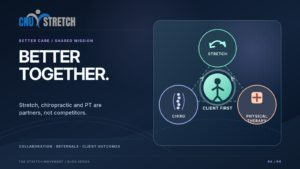
The goal is the same for everybody in the room: the client gets an effective stretch, the joint gets the care it needs, and the client feels like they have a team.
Find the root, not the symptom
One of my favorite examples in class is the piriformis. A client comes in with sciatic-type pain. You stretch the piriformis, it takes load off the sciatic nerve, and they feel better. But the root of the problem is usually glutes that aren’t firing. Get the glutes working, and the piriformis doesn’t have to do their job anymore.
Arthrokinematics is the same lesson one layer deeper. Sometimes the muscle is the symptom, and the joint is the root. The best stretch therapists I know aren’t the ones who stretch the hardest. They’re the ones who notice, ask better questions and know who to call.
That’s why I’m so grateful to Dr. John Dabbs and Dr. Debbie Dabbs for opening up their playbook on Episode 4.
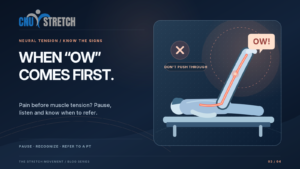
Next up: the other big “stop and refer” moment, when the client says “ow” before you even feel tension. Read When the Client Says Ow Before You Feel the Stretch: Dural Tension, Nerve Flossing and When to Refer.
Want to learn the assessment, the end-feel training and the referral system we teach every stretch professional? Check out the CNU Stretch Certification and join The Stretch Movement on Facebook.
This article is for education. It isn’t medical advice, and it doesn’t replace an evaluation by a licensed chiropractor, physical therapist or physician.