A Chiropractor and a Physical Therapist Walk Into a Stretch Podcast
By Evans Armantrading, CEO of CNU Stretch · Stretch Therapy Education
The Stretch Movement, Episode 4: what a chiropractor with 30 years in practice and a doctor of physical therapy taught me about the real value of stretch.
Let me be honest with you. When I started The Stretch Movement podcast, the mission was simple: help 1,000 people generate $100,000 a year in stretch revenue. The first three episodes were me laying out my background, the systems and the mindset you need to build a stretch business.
But here’s the thing. Before you can build a great program, you have to have a great product. It doesn’t matter how great your customer service is. It doesn’t matter how great your systems are. If the burger is not good, it doesn’t matter.
And in stretch, the burger is what happens on the table.
So for Episode 4, I wanted to step away from business for a minute and geek out on the human body: how we move, why we stop moving well, and what’s really going on when a client says “I’m tight.” And I wanted to hear it from people who see the body from a different angle than a stretch therapist does. A chiropractor and a physical therapist.
If you’re a stretch therapist, a trainer, a gym owner or a clinic owner, this one is for you. And honestly, if you’re someone who just wants to keep moving well into your 70s, 80s and 90s, it’s for you too.
Meet Dr. John Dabbs and Dr. Debbie Dabbs
I want you to understand who you’re hearing from. These are not people who opened a stretch book a couple of weeks ago. They are at the top of their professions, and they’ve built what most people in our industry dream of: a full movement solution under one roof in Eden, North Carolina.
Dr. John Dabbs, D.C. has been practicing chiropractic in Eden since 1996. That’s 30 years of putting his hands on people. He studied exercise science and biology at East Carolina University, earned his Doctor of Chiropractic from Life University, and is a certified sports physician. He leads Eden Chiropractic, where his team sees about 100 patients a day.
What I love about John is how he looks at people:
“We look at everyone as an athlete, whether you’re a 90-year-old grandmother who’s just trying to get up off the couch. That’s your sport of choice.”
He’s been looking at individuals “from a movement pattern as opposed to a pain pattern for a long, long time.” That one sentence is the whole philosophy of stretch.
Dr. Debbie Dabbs, PT, DPT, M.Ed. leads ProTherapy Concepts, the physical therapy practice right next door. She was a collegiate gymnast and cheerleader at the University of Georgia, holds a B.S. in Exercise and Sport Science and a Master of Education from UGA, a Master of Physical Therapy from Winston-Salem State University and a Doctorate in Physical Therapy from Shenandoah University. She taught health and physical education for seven years before becoming a PT, and she’s spent more than 20 years in acute care, outpatient, nursing home and home health settings. She told us she was the youngest gymnastics judge in the state of Georgia, because she could sit and analyze a skill and judge it.
“I love watching people move and analyzing gait and biomechanics, and figuring out what injury they have, or what injury they’re going to have down the road.”
Together, John and Debbie also own NC Reps, a performance and fitness facility. Chiropractic, physical therapy, personal training, and now stretch therapy, all working together. About a year ago, their team went through the CNU Stretch certification. So when they talk about stretch, they’re talking from the clinic floor.
Pain is the last thing to come and the first thing to go
My first question was simple: what’s the biggest misconception people have about pain, stiffness and mobility?
Dr. John didn’t even hesitate:
“To me, pain is the last thing to come, the first thing to go.”
Think about that. Unless there’s a traumatic injury, by the time someone feels pain, they’ve already had a problem for a while. They just didn’t know about it. John compared pain to that red warning light on your dashboard, the one we all ignore because we’re tough:
“We always say the five most deadly words: maybe it’ll go away.”
Here’s why that matters for us as stretch professionals. If pain is the last thing to show up and the first thing to leave, then just because the pain went away doesn’t mean the problem went away. John’s process is to get rid of the pain, then heal the tissue, then strengthen the tissue so it doesn’t come back.
That’s why they put people on a maintenance rhythm. A young, active person might come in every three to six months. Someone who gets beat up every day, like a Brazilian jiu-jitsu athlete, or a grandmother with osteoporosis and arthritis, comes in more often, so they catch issues before they become major problems.
And Dr. Debbie added the part that gave me chills. Things don’t happen overnight unless there’s a traumatic experience, but “one little micro injury or dysfunction can lead to really bad things down the road.” In more than 20 years as a PT, she’s watched small movement problems turn into arthritic changes, surgeries and pain that never had to happen “if someone just figures it out early enough.”
Get your movement checked like you get your teeth checked
This was the moment I said, “Honestly, you’re the first person I’ve ever heard say that.”
Dr. Debbie is a huge advocate of what she calls the dentistry model:
“We need to move into the dentistry model, where we go and have our movement analyzed every six months, like you get your teeth checked every six months.”
Posture. Gait. Balance. Can you get down on the floor and back up? Can you transfer? If you’re assessed every six months, you can catch the deficits that are going to turn into a pain problem.
The problem is the system. As Debbie put it, in the medical field “we’re dictated by insurance, and we can’t see you until there’s already a problem. Unless you’re in a cash-based service like stretch, which is great.”
Stretch therapists, read that again. A doctor of physical therapy just told you that cash-based stretch fills a gap the insurance model can’t.
And here’s why it matters so much. People don’t feel the problem coming, because the body is brilliant at compensating. Debbie said you can still grab the cinnamon off the spice rack, but you’re using a totally different muscle group than you did before. And then:
“Half these people are having rotator cuff tears and don’t even know it.”
That substitution leads to more degeneration, joint replacements, all the things. The good news, in her words: “It can be fixed so quickly” when it’s caught early. That is the role of a great stretch therapist. Every session is a chance to notice what’s changing before it becomes pain.
What we do early is what we get late
So many of our clients are over 40, many over 50, and I hear the same thing every week: “I’m just getting older. My body doesn’t move like it used to.” So I asked: how much of that is really aging, and how much is lifestyle?
John answered with a story. He met Jack LaLanne when LaLanne was 90 years old. LaLanne jumped on the ground, did 50 push-ups, and then got up and kept talking like nothing happened. Wasn’t even breathing hard. And LaLanne’s whole philosophy was this:
“What we do early is what we get late.”
What we do at 20, 30 and 40 decides how we live at 70, 80 and 90. John compared it to a retirement account. You put in a little, consistently, and it pays dividends in the long run. His advice: “Be comfortable being uncomfortable.” Put your movement on the calendar like an appointment, and get in your 10, 15, 30 minutes a day.
Then we got into what years of sitting actually do to the body. Debbie walked through it: muscle atrophy, posture-related changes, soft tissue that shortens, overactivity in the wrong places. “Your body basically gets stuck in that position and it forgets what to do.” And her line that stuck with me:
“If you’re not getting stronger, you’re getting weaker, for sure. Sitting’s the new smoking.”
John took it to the nervous system. When we don’t train it, everything slows down, including how fast the muscle fibers fire. So when you miss a step off a curb, you don’t have the reaction time you had at 20. The risk of a fall goes up. The risk of a broken hip goes up.
The fix isn’t becoming Arnold Schwarzenegger. In John’s words, “We need to move at a little higher capacity than what we move at throughout our general day.” One step at a time, and it keeps you one step ahead of injury and sickness.
Tight doesn’t always mean “stretch it”
This is the question I was most excited to ask: when someone feels tight, is that always a sign they need a stretch?
John’s answer dropped the bomb. From a chiropractic standpoint, tightness can come from what he called arthrokinematic restrictions, problems in how the joint itself moves:
“The muscle integrity may still be there, but they may have something underlying, underneath that muscle integrity, that may be dysfunctional also. And that’s where osteoarthritis shows up. That’s where joint dysfunction starts to show up.”
So picture the client with chronic low back pain. You stretch their low back. You stretch their hamstrings. They’re doing their homework. And they’re still chronically tight. John says that’s when you dig deeper. Is it really the hamstring? Or is it ankle mobility changing the way they walk? A disc issue, or degeneration in the facet joints, so the hamstrings tighten up “because now they’re in a protection mode”?
He walked us up the kinetic chain from the ground. He’s seen ankle dysfunction show up as jaw clenching: a pronated foot pushes the head forward, and a forward head means a tight jaw. An old ankle sprain from 10th grade stops absorbing shock, so the shock goes somewhere. Left ankle, then right knee, then left hip, “zig-zagging its way up the kinetic chain trying to find a pressure release.”
“The Lord made us in the perfect image, a perfect machine. So we have the ability to adapt to a lot of dysfunction. What happens is we keep adapting, keep adapting, until it becomes a pain problem.”
His rule for us on the table: if the same hamstring keeps coming back tight, and the right side doesn’t match the left, there’s probably something else going on in the chain that this person is adapting to.
I broke this down further in the next post, because every stretch therapist needs to understand it: Still Tight After Stretching? It Might Be the Joint: Arthrokinematics for Stretch Therapists. It covers what arthrokinematics is, how stretch affects the joint, and when to refer to a chiropractor.
Knowing when to stop, and when to refer
Here’s where I wanted to protect our stretch therapists. Most people listening don’t have a chiropractor and a PT next door. So how do you know when a challenge is outside your scope?
Dr. Debbie took this one, and it’s gold. Every stretch therapist needs a clear picture of what normal feels like:
“The patient or the client can say red, yellow, green, and that’s fine. But what is their face looking like? Does it feel like a springy feel, or does it feel like a hard end feel?”
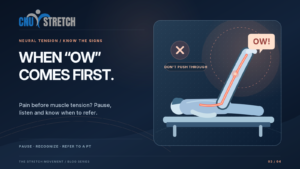
Then she described the moment every stretch therapist needs to recognize. You’re taking a hamstring stretch, the leg is way down low, you don’t feel any tension yet, and the client says “ow.”
“Like the patient’s feeling pain, but you’re not feeling the stretch. There’s some dural tension in there. They’re probably having some low back dysfunction.”
That’s your sign. You’re not going to stretch through that. In my words on the show: we have to be humble enough to say, “OK, cool, we’ll finish up today’s session, we’ll do some other things, but here’s what I recommend.” Nerve-type symptoms and nerve flossing are not within our scope of practice. That belongs with a physical therapist.
And I want every stretch pro to hear this part too:
“I don’t think stretch needs to be discontinued. It’s always a great adjunct, and there’s plenty of other things to stretch.” Dr. Debbie Dabbs
She said the client will appreciate you referring them out. You keep stretching the areas that are safe, you work alongside the PT, and the client still gets an effective session.
She and John also gave us the red flags for when someone should not be stretched until they’re medically cleared: a lot more pain after a session, unusual swelling and strong calf pain (think DVT), and difficulty breathing when they lie down. “That’s where we say, let’s get a medical eval first.”
This is a deep topic, so I wrote a full post on it: When the Client Says Ow Before You Feel the Stretch: Dural Tension, Nerve Flossing and When to Refer.
One more thing I said on the show that I’ll stand behind forever: yes, our goal is to create revenue, but you don’t start in wellness with the goal of making money. You start by helping the client. Help enough people, and you’ll create what you want.
Stretch before the adjustment, and what stretch did for their clinic
We have chiropractors in our area who refer patients out for stretch, so I asked John straight up: before or after the adjustment?
“I like my patients to be stretched first.”
His reasons: stretch increases circulation, loosens up the joint structures, and makes patients “a little bit more compliant on the table.” A lot of their joint receptors are already woken up. As a full-spine practitioner who puts his hands on people, he doesn’t have muscle restrictions fighting him when he delivers an adjustment, and it’s more comfortable for the patient. Some of his patients alternate: chiro, then stretch two weeks later, then chiro again. “From a practitioner standpoint, I see the most value in them getting stretched and then coming to me.”
Then it moves into corrective exercise. Stretch, adjust, then quadruped diagonals, side planks, high-knee marches, working on toe-off. John called it “a nice evolution of how we start to build a better patient.” Build a better burger, build a better patient. Amen.
And every patient hears it. Eden Chiropractic sees about 100 patients a day, and John said, “Every single one of them, we say, we need you stretching. We need you increasing your mobility.” Muscles are like ropes, he tells them, and when those ropes stay tight you lose the ability to do the things that make you smile. Stretch also calms the nervous system, the same way you rub your head after you bump it: “That’s what stretch does for us.”
Now the business side, because the truth for every business is the P&L. We can love what we do, but if we don’t make money, we can’t serve the people we’re called to serve.
About a year after their team got certified, here’s what John shared:
- Stretch revenue: between $7,500 and $10,000 every four-week cycle
- A new role: Cooper, who used to be their “Swiss Army knife,” is now pretty much full-time stretch
- More of the team: four other team members stretch, which gives them a break from their normal wear and tear
- Community reach: a stretch event for the Guilford County school system, and conversations about monthly wellness visits at Purina
And the line I’ll never forget:
“Even from a small, socioeconomically deprived area, people find value in stretch.”
When you can help me feel better, move better and live longer, I’ll pay for that.
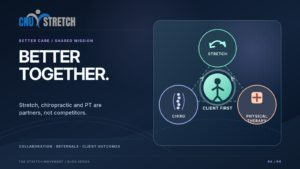
So is a chiropractor or a PT competition for a stretch therapist? I wrote a whole post on that question: Are Chiropractors and Physical Therapists Competition for Stretch Therapy?
Join the movement
John and I once spent almost two hours geeking out about movement when he was supposed to be doing patient notes. This episode was that conversation, and I’ll be honest with you: I’m going to come back and listen to it a couple of times. I come out of it sounding smarter.
Here’s what I want you to take with you:
- Pain is the last thing to come and the first thing to go. Gone pain doesn’t mean a fixed problem.
- Movement deserves a check-up like your teeth do. Cash-based stretch can catch what insurance waits on.
- Tight doesn’t always mean “stretch it.” Sometimes it’s the joint, and sometimes it’s a nerve.
- Know your scope, and keep stretching what’s safe. Refer out, partner up, and stay in the client’s corner.
- Chiropractic, physical therapy and stretch make each other better.
Thank you, Dr. John and Dr. Debbie, for your time and your wisdom. If you’re in the Eden, North Carolina area, go see them at Eden Chiropractic, ProTherapy Concepts and NC Reps.
Want to go deeper? Join The Stretch Movement on Facebook, where we share every episode and talk shop with stretch professionals every week.
Want to do this for a living? The CNU Stretch Certification teaches the assessment, the techniques and the business system that helped the Dabbses’ team build stretch into their practice. Come join the movement.