Are Chiropractors and Physical Therapists Competition for Stretch Therapy?
By Evans Armantrading, CEO of CNU Stretch · Stretch Therapy Education
From The Stretch Movement, Episode 4, with Dr. John Dabbs, D.C., and Dr. Debbie Dabbs, PT, DPT. The rest of the series: the episode recap, arthrokinematics and dural tension.
I get this question from both sides of the table.
From stretch therapists: “Evans, if I refer my client to a chiropractor or a PT, aren’t I just handing them my client?”
And from chiropractors and physical therapists: “If my patients start going to a stretch studio, aren’t they going to need me less?”
Same fear, different uniform.
I’m going to give you the answer. I’m also going to show you how a chiropractor with 30 years in practice and a doctor of physical therapy with more than 20 years built stretch right into their clinic, and what it did for them.
But not yet. Because before we can answer “Is this competition?” we have to talk about the lens you’re looking through when you ask it.
Scarcity mindset vs. abundance mindset
There are two ways to look at the person down the street who also helps people move better.
Scarcity says there’s only so much pie. Every client they get is one I lose. So I hold on tight. I don’t refer out, even when I should. I talk down the other guy. I compete on price. I keep my clients close and my knowledge closer.
Abundance says the pie isn’t even close to being eaten. There are more people who need help moving than all of us combined could ever serve. So I do what’s best for the client, I refer when I hit the edge of my scope, I build relationships, and I trust that when I serve people well, I’ll have more than enough.
Let me tell you why abundance isn’t wishful thinking. Look at what Dr. Debbie said on the episode about how most people get care:
“Unfortunately, in the medical field, we’re dictated by insurance, and we can’t see you until there’s already a problem.”
Think about how many people are walking around right now with a stiff hip, a shoulder that doesn’t move right or a back that “just does that sometimes,” and they haven’t seen anyone. Debbie put it bluntly: “Half these people are having rotator cuff tears and don’t even know it.” The market isn’t crowded. It’s under-served.
Now, abundance doesn’t mean you don’t care about money. On the show I said it: I believe it’s a calling we have as entrepreneurs to be profitable. If we don’t make money, we can’t serve the people we’re called to serve. Scripture says, “Beloved, I wish above all things that thou mayest prosper and be in health, even as thy soul prospereth” (3 John 1:2). His desire is that we’re successful in what we do.
Abundance is just the belief that you get there by adding value, not by guarding territory.
Here’s the test. When a client needs something you can’t give them, what’s your first thought? “How do I keep them?” Or “Who’s the best person to help them?” Your answer tells you which mindset is running your business.
Different practices, different lanes
When you look at it from abundance, you start to see that every kind of practice in the movement world has a lane, a thing it does better than anyone else. Here’s how I see it:
| Practice | What it does best | Where it runs into limits | Where stretch fits |
|---|---|---|---|
| Chiropractic office | Assesses and adjusts the joints and spine | Short visits; muscles can fight the adjustment | Stretch before the adjustment, and between visits to keep patients moving |
| Insurance-based PT clinic | Rehab after injury or surgery, nerve and movement problems | Insurance limits visits and won’t pay for prevention | Ongoing, cash-based care after discharge, and the six-month movement check-ups Debbie wants |
| Cash-based PT or performance clinic | Longer, more personal sessions, prevention, athletes | Price limits how often people come | A lower-cost, high-frequency service that keeps clients engaged between PT visits |
| Gym or personal training studio | Strength, conditioning, accountability | New or older members can feel threatened by hard training | The “least aggressive way” to start moving, recovery for members, and a new revenue line |
| Stand-alone stretch studio | Frequent hands-on sessions, relationship, relaxation and mobility | Can’t diagnose, adjust joints or treat nerves | Its own lane, and the client’s early warning system, with a referral network behind it |
| Integrated practice (like the Dabbses’) | Chiro, PT, training and stretch under one roof | It takes years and real investment to build | Woven into every patient’s plan |
Notice something? Every lane has a limit, and the limit of one lane is the strength of another.
The chiropractor can’t spend 50 minutes a week with every patient. The PT can’t keep seeing someone after insurance says they’re done. The trainer can’t treat a nerve. And the stretch therapist can’t adjust a joint or prescribe nerve glides.
But the stretch therapist sees the client more often than anyone else in that list, and that’s a superpower.
How the Dabbses built stretch into their practice
Dr. John Dabbs has been practicing chiropractic in Eden, North Carolina, since 1996. Dr. Debbie Dabbs, PT, DPT, M.Ed., a former University of Georgia gymnast, has more than 20 years as a physical therapist. Together they run Eden Chiropractic, ProTherapy Concepts and the NC Reps training facility. If anyone had a reason to see stretch therapy as competition, it’s them.
Instead, about a year ago, they brought our team to Eden and got their staff certified, from the front desk to a doctor of chiropractic. Here’s how stretch lives in their practice now, in their own words.
Every patient hears about stretch.
“Every single patient comes through our office, every single one… the Lord’s blessed us, we see about 100 patients a day on the chiro side. Every single one of them, we say, we need you stretching. We need you increasing your mobility.” Dr. John Dabbs
Stretch is the easiest first step. John said passive stretch at the start of care “just gives us more buy-in.” When you tell a nervous patient they’re going to a personal trainer, they think sweat and soreness. Stretch is “the least aggressive way to get patients to start to move and feel better,” and once they feel the difference, they ask, “What’s the next step?”
Stretch comes before the adjustment.
“I like my patients to be stretched first… From a practitioner standpoint, I see the most value in them getting stretched and then coming to me.” Dr. John Dabbs
Some patients alternate, chiropractic one week and stretch two weeks later. Then they move into corrective exercise. John called it “a nice evolution of how we start to build a better patient.”
Stretch fills the gap insurance leaves. Debbie wants people’s movement checked every six months, like their teeth. Insurance won’t pay for that, “unless you’re in a cash-based service like stretch, which is great.” And when a stretch client needs her, “stretch doesn’t need to be discontinued. It’s always a great adjunct.”
Stretch grew the business, and the team. About a year in, John shared:
- They run between $7,500 and $10,000 in stretch revenue every four-week cycle.
- Cooper Smith, who used to be their “Swiss Army knife” across the PT team and NC Reps, is now pretty much full-time stretch. Stretch let them hire him specifically for it.
- Four more team members stretch, which “pulls them out of what their normal job capacity is and gives them a little break from their normal wear and tear.”
- They’re training three new personal trainers to stretch too.
- They took stretch to the Guilford County school system, and they’re working out monthly wellness visits at Purina.
And the relationship piece surprised them. Stretch clients bond with their stretch therapist: “You develop that one-on-one. You tell some secrets in there, and you start to be investing in their life.”
Here’s how John summed it up:
“This just wasn’t a little spur-of-the-moment thought process, like, hey, let’s add one more spoke to our wheel. This was something that really complements everything that we do and everything that we believe in. It fits our core values and our mission statement very well. Our staff enjoys it, and our community has really embraced it. Even from a small, socioeconomically deprived area, people find value in stretch.”
When you can help me feel better, move better and live longer, I’ll pay for that. And the answer came right back from Eden: “That’s exactly right. I’ll find the revenue to cover that.”
The answer: complementing, not competing
So, are chiropractors and physical therapists competition for stretch therapy?
No. They’re teammates.
The Dabbses didn’t treat stretch as a threat to chiropractic or physical therapy. They used it to make chiropractic and physical therapy work better. The patient gets stretched, the adjustment goes easier, the corrective exercise sticks, and the patient stays engaged between visits. Every service makes the next one more effective.
And it works the other way too. A stretch therapist with a great chiropractor and a great PT in their corner can say yes to more clients, not fewer. You can take the client with the stubborn hip, because you know who to call when the end feel turns hard. You can take the client with the old back injury, because you know the red flags and you’ve got a PT who’ll see them. And when they refer out, Debbie said it best: “Stretch doesn’t need to be discontinued. It’s always a great adjunct.”
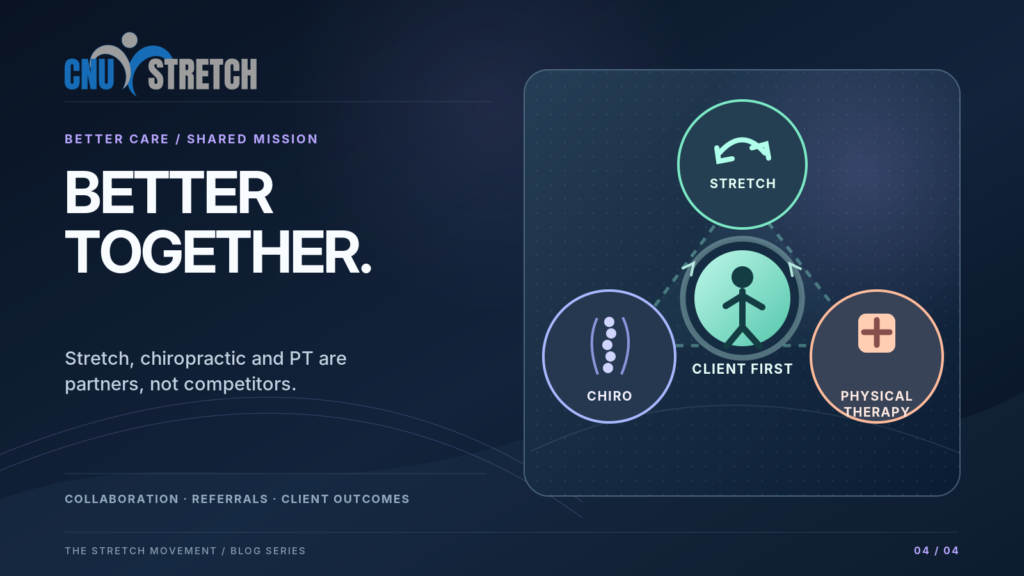
Here’s how I see the whole team around one client:
- The stretch therapist sees them most often, keeps them moving, and notices changes early.
- The chiropractor keeps the joints and spine moving the way they should.
- The physical therapist rehabs injuries, treats nerve and movement problems, and builds the plan.
- The trainer builds the strength that keeps it all from coming back.
Nobody in that list is replacing anybody. As Dr. John’s process goes: get rid of the pain, heal the tissue, then strengthen the tissue so it doesn’t come back. That takes more than one set of hands.
On the show I said, “We may partner with… one could support the other.” After this conversation, I’d say it stronger. These are not competing services. They’re complementing services, and together they help people move well for life.
How to build referral partnerships in your town
Abundance is a mindset, but partnerships are a system. Here’s how to build yours, whether you’re a stretch therapist, a gym owner or a clinic owner.
- Make your list. Write down three chiropractors and three physical therapists within 15 minutes of you. Ask your clients who they see and love.
- Know your lane before you knock. Be able to explain, in one minute, what you do, what you don’t do, and your red-flag protocol. (Use the arthrokinematics and dural tension posts.) Clinicians refer to people who know where their scope ends.
- Give first. Offer to stretch their staff for free. Their front desk and their techs are on their feet all day. Let them feel the product.
- Offer something that makes their work easier. For a chiropractor: “I’d love to stretch your patients before their adjustments.” For a PT: “When your patients are discharged, I can keep them moving between their check-ups.”
- Refer first, and refer well. Send the client with notes: side, range, end feel, what changed and what they felt. Good notes are how a clinician learns to trust you.
- Follow up. After a referral, ask the client how it went, and send the practitioner a short thank-you. Ask, “Anything you want me to avoid or focus on?”
- Do something together in the community. The Dabbses took stretch to a county school system and a corporate wellness program. Co-host a mobility workshop at a gym, a church or an employer.
- Stay in touch every month. Partnerships are relationships. Drop by, send a note, share a win.
Do that for 90 days and you won’t be wondering whether they’re competition. You’ll be wondering how you ever did it without them.
Join the movement
When we launched The Stretch Movement, the goal was to help 1,000 people generate $100,000 a year in stretch revenue. You don’t get there by fighting over the same few clients. You get there by growing the whole pie: more people getting assessed, more people moving, more people with a team around them.
That’s what John and Debbie are doing in Eden, North Carolina. And John told me the support matters as much as the training:
“Every time that we’ve reached out to you, you’ve been available. Your team has been available.”
Thank you, Dr. John Dabbs and Dr. Debbie Dabbs, for showing all of us what abundance looks like in a real practice. If you’re near Eden, go see them at Eden Chiropractic, ProTherapy Concepts and NC Reps.
If you’re a chiropractor, PT, trainer or gym owner thinking about adding stretch to your practice, the CNU Stretch Certification trains your whole team, from the front desk to the doctors, and gives you the system to make it a real revenue line.
If you’re a stretch therapist ready to build your referral network, come join The Stretch Movement on Facebook. That’s where we talk shop every week, and where you’ll find people who think in abundance.